FactWhy Bali became a yoga destination
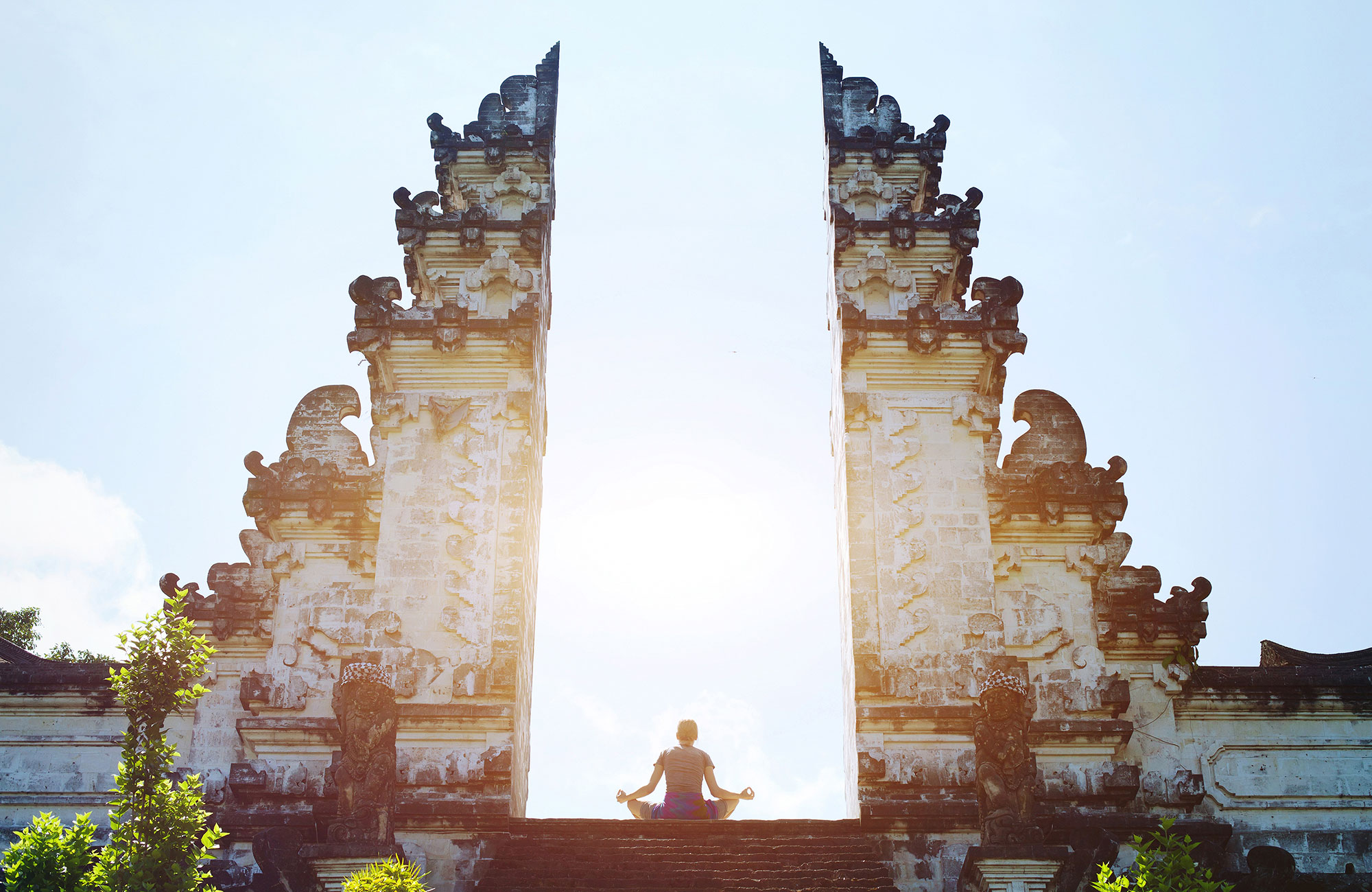
Bali's yoga scene grew from Ubud's centuries-old spiritual life: Hindu temples, healers and daily offerings made the island a natural home for yoga, meditation and breathwork. Foreign teachers began settling in Ubud in the 1990s and 2000s, and the island now draws more retreat bookings than almost anywhere else on earth — over one in ten retreats booked worldwide is in Bali. Bali set a record of 6.95 million foreign arrivals in 2025, and wellness is now at the centre of its tourism.
FactThe Eat Pray Love effect
Elizabeth Gilbert's memoir Eat Pray Love was published in 2006 and filmed in Ubud for its 2010 release, starring Julia Roberts. The book and film put Ubud's yoga shalas, healers and rice terraces in front of a global audience, and Bali's foreign arrivals more than doubled between 2006 (1.26 million) and 2010 (2.58 million). Ubud's wellness boom, already growing since the 1990s, accelerated sharply from that point.
PlaceUbud: the yoga capital
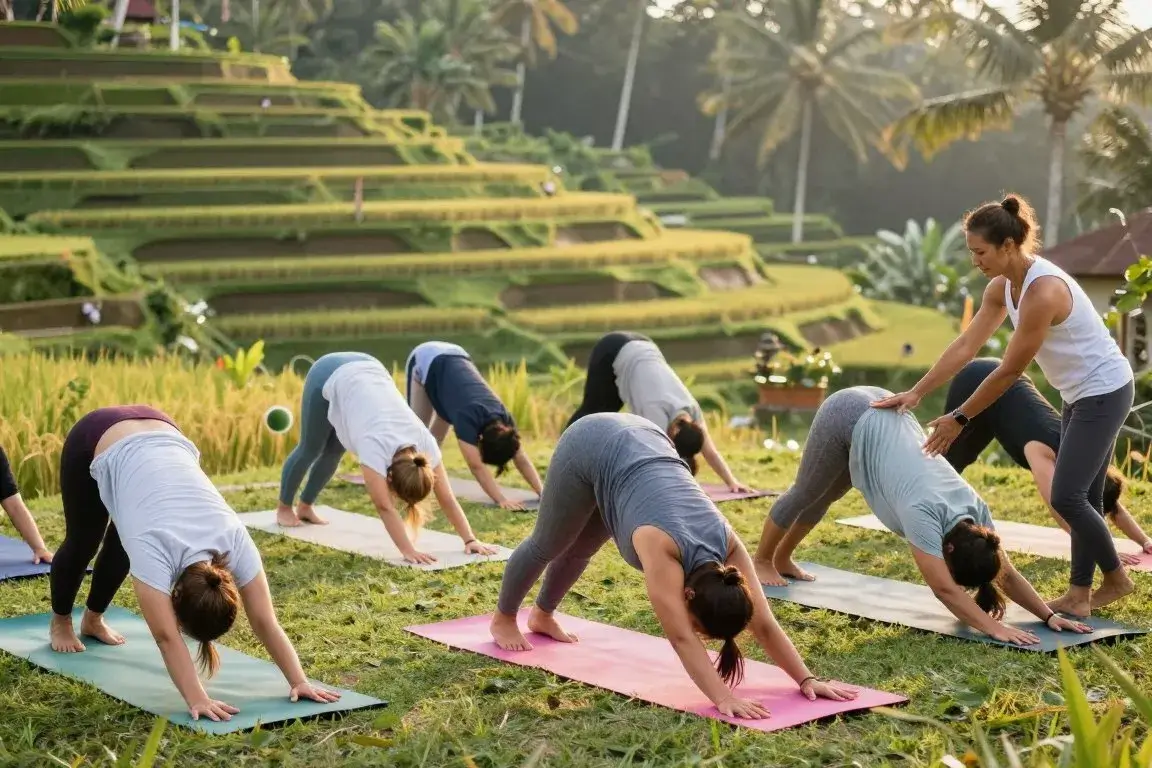
Ubud is Bali's yoga capital, with the island's deepest concentration of studios, teachers and trainings, surrounded by jungle, rice terraces and temples. One listings guide counted 454 health and wellness events in Ubud over three weeks in November 2026, more than the rest of the island combined. It suits travellers who want depth and variety: traditional Hatha, Yin and Ashtanga sit alongside sound healing, breathwork and teacher training.
PlaceThe Yoga Barn
The Yoga Barn, on Jl. Hanoman in Pengosekan, Ubud, is Bali's most famous yoga centre, founded in 2007 and now one of the largest in Southeast Asia. It runs more than 180 classes a week across eight studios, from Hatha, Vinyasa, Yin and Kundalini to Pilates, sound healing and ecstatic dance, plus an Ayurvedic spa, guest houses and the Garden Kafe. A single drop-in class costs around IDR 180,000, with mats and props included, and it is also the home of the BaliSpirit Festival.
PlaceRadiantly Alive
Radiantly Alive, at Jl. Jembawan No. 3 in central Ubud, has been a much-loved studio since 2010, rated 4.9 from more than 2,600 reviews. Its signature is flowing Vinyasa, alongside Yin, restorative and meditation, in 75-minute classes open to all levels. It also runs 200- and 300-hour teacher trainings in its own Vinyasa style, and its community extends to retreats in Bali and Europe.
PlaceAlchemy Yoga & Meditation Center
Alchemy, at Jl. Penestanan Kelod No. 75 in Ubud, teaches traditional Hatha and tantra through its own system in which every class is built on an element: Earth, Water, Fire, Air, Ether and Krama. The timetable also has Yin, Flow, Slow Flow, pranayama, kirtan and ecstatic dance, and it runs 200- and 300-hour Yoga Alliance trainings. A five-class pass costs around IDR 650,000 and also works at Alchemy's second studio in Uluwatu, on Bingin beach.
PlaceUbud Yoga House
Ubud Yoga House, on Jl. Subak Sokwayah, is the quiet alternative to the big centres: a small open-air shala among the rice fields, reached on foot or by scooter, with classes capped small so teachers can give personal attention. Its four daily classes are sunrise yoga, slow vinyasa, yoga for beginners and gentle yoga, each about 75 minutes and around IDR 150,000, with mats free and tea, coffee and lemon water on the house. It is closed on Sundays.
PlaceCanggu: yoga with the surf crowd
Canggu pairs yoga with beach culture, digital nomads and surf, and its studios are spread across Batu Bolong, Padang Linjong, Pererenan and Seseh. Drop-in classes run about IDR 139,000 to 170,000, and the scene is younger and more social than Ubud's, with cafes, beach clubs and recovery studios nearby. Pick a studio near where you are staying: the shortcuts between villages are scooter-only, and most studios do not admit late arrivals.
PlaceThe Practice, Canggu
The Practice, at Jl. Batu Bolong 94A in Canggu, is the town's home of traditional Hatha, taught in an open bamboo shala alongside Yin, meditation and Qi Gong. Most classes run 75 minutes and a drop-in costs around IDR 170,000, with a 10-class pass around IDR 1,350,000. Arrive 10 to 15 minutes early: there is strictly no late entry, and you do not need to book.
PlaceSamadi Bali
Samadi Bali, near Echo Beach in Canggu, is a yoga and wellness community with daily classes, workshops, holistic treatments and an organic cafe, plus a popular Sunday market. It is known for a strong Ashtanga programme alongside Hatha, Yin and other styles. A single class costs around IDR 155,000 for visitors, with a 12-class pass around IDR 1,550,000 and a monthly pass around IDR 3,300,000.
PlaceDesa Seni: a yoga village
Desa Seni is a living wellness village built from antique Indonesian wooden houses, or joglo, set among organic gardens, with daily open-air yoga classes, farm-to-table meals and a strong community feel. It is a stay-and-practice place rather than a drop-in studio: guests sleep in the restored wooden homes and join the daily rhythm of sunrise yoga, meditation and shared meals. It suits travellers who want a slower, village-style retreat rather than a busy studio timetable.
PlaceUluwatu: clifftop yoga
Uluwatu's yoga happens on the cliffs above the surf: small studios such as Morning Light Yoga at Uluwatu Surf Villas, La Tribu Bali and Ulu Yoga run sunrise and sunset sessions with ocean views. Resorts here also offer the island's most dramatic specialty classes, including stand-up paddleboard yoga in infinity pools and aerial yoga in cliff-edge cabanas. Come for the setting as much as the practice, and pair a morning class with the Kecak fire dance at Uluwatu Temple in the evening.
PlaceSanur: calm-water SUP yoga
Sanur is the home of Bali's stand-up paddleboard yoga: its beach has no waves near the shore, and the water is clear, warm and shallow enough to see the reef below. SUP Yoga Bali, the first operator of its kind on the island, runs classes on anchored boards off Sanur beach, combining paddling with a gentle yoga flow. It is the calmest place in Bali to try yoga on the water, and a good choice for beginners.
FigureWhat a drop-in class costs
A single drop-in yoga class in Bali costs roughly IDR 140,000 to 180,000, about USD 9 to 12, with mats and props almost always included. The Yoga Barn charges around IDR 180,000, The Practice in Canggu around IDR 170,000, Ubud Yoga Centre around IDR 165,000 and Samadi around IDR 155,000. Indonesian residents and KITAS holders usually pay less, and prices are marked approximate, so check the studio's own price page before you go.
FigureClass passes: better value if you stay a while
If you plan to practise more than a couple of times, a class pass saves money. At The Yoga Barn, 10 classes cost around IDR 1,500,000 and a 30-day unlimited pass around IDR 3,300,000; Radiantly Alive charges about the same for 10 classes and around IDR 3,000,000 for a month unlimited. Passes are usually non-refundable, non-transferable and expire within 30 to 60 days, so buy a small pack first if you are only passing through.
FactThe styles on offer: Hatha, Vinyasa, Yin
Hatha is the slow, classical foundation: held poses, breathing and alignment, and the best starting point for beginners. Vinyasa links breath to flowing movement and is the most common style in Bali's big studios, from gentle slow flow to sweaty power vinyasa. Yin is the opposite: long, passive holds of three to five minutes, mostly on the floor, aimed at deep stretching and stillness, and it is usually the last class of the day.
FactAshtanga and Mysore-style practice
Ashtanga is a fixed, athletic sequence of poses linked by breath, traditionally practised early in the morning. In Mysore style, students practise the sequence at their own pace in a shared room while the teacher adjusts each person individually, rather than following a led class. Samadi in Canggu and Ubuntu Bali in Tibubeneng both run dedicated Mysore programmes, with drop-ins around IDR 160,000 to 250,000. It suits experienced practitioners who want a disciplined daily practice.
FactKundalini and breathwork
Kundalini yoga works with breath, chanting, movement and meditation to raise energy through the body, and it is a Bali staple: The Yoga Barn runs Kundalini classes and even a 200-hour Kundalini teacher training. Breathwork, or pranayama, appears across the island too, from gentle breathing in a Hatha class to full ceremonial breathwork sessions at Alchemy and the BaliSpirit Festival. These are the most spiritual styles on offer, so expect chanting, mantras and group energy rather than a workout.
FactAerial yoga: yoga in a hammock
Aerial yoga hangs you in a fabric hammock about a metre above the floor, so you can stretch, invert and float with the fabric taking your weight. It tones and stretches the whole body and lets the spine decompress in a way floor yoga cannot, and it is popular with travellers who want something playful. Serenity Eco Guesthouse in Canggu is known for aerial classes, and several Uluwatu resorts offer it in cliff-edge cabanas. No experience is needed, but tell the teacher about any back, neck or blood-pressure issues first.
FactSUP yoga: yoga on a paddleboard
SUP yoga, short for stand-up paddleboard yoga, is a yoga class on a paddleboard floating on the water, and it turns balance into the whole practice: every pose works your core as the board moves beneath you. Sanur's calm, shallow water is the classic spot, and there are also sessions on Jimbaran Bay at Kelan Beach, where a group class costs around IDR 450,000 per person. Beginners start on their knees, and falling in is part of the fun, so wear swimwear and bring a towel and sunscreen.
PlaceSound healing at Pyramids of Chi
Pyramids of Chi, in Bentuyung about three kilometres north of Ubud, is a purpose-built sound healing centre with two large pyramids modelled on the Great Pyramid of Giza. Its signature Ancient Sound Healing session runs about 90 minutes, several times daily from 10am to 8pm, and costs around IDR 350,000; you simply lie on a mat while practitioners play gongs, crystal bowls, didgeridoos and chimes. A free hourly shuttle runs from central Ubud, and children under 14 are not admitted.
FactBaliSpirit Festival
The BaliSpirit Festival is Bali's great annual yoga gathering, founded in 2008 by Kadek Gunarta and Meg Pappenheim in the aftermath of the 2002 and 2005 bombings, as a community gathering for healing. It runs for five days each April at The Yoga Barn and the neighbouring Puri Padi hotel in Ubud, with daytime yoga, meditation, breathwork, sound healing and dance, and live world music by night. The 2026 festival ran 15 to 19 April, and the next is scheduled for 22 to 25 April 2027; the opening days are often free to attend.
Fact200-hour teacher training: what it is
A 200-hour yoga teacher training is the entry-level Yoga Alliance certification, and Bali is one of the world's most popular places to do it, with more than 20 registered schools in Ubud alone. Courses run 21 to 28 days, typically starting at 6 or 7am with eight to ten hours a day of asana, pranayama, meditation, anatomy, philosophy and teaching practice. Graduates can register as RYT-200 teachers, and many schools include accommodation, meals and cultural excursions in the fee.
FigureWhat a teacher training costs
A 200-hour teacher training in Bali costs roughly USD 1,500 to USD 4,200, with most programmes running three to four weeks and including shared accommodation and daily meals. At the budget end, schools such as Yogmantra Bali start from around USD 1,500, while Blooming Lotus Yoga in Ubud charges from around USD 2,490 for its 200-hour course plus a 25-hour meditation certification. Radiantly Alive's 24-day Vinyasa training starts from around USD 3,100, not including accommodation. Check what is included before you book, as meals, rooms and excursions vary widely.
FactYoga retreats: what a week looks like
A typical Bali yoga retreat runs four to seven days and follows a daily rhythm: sunrise yoga and meditation, a healthy breakfast, a second session or workshop in the afternoon, and restorative yoga or sound healing in the evening. Most include accommodation, two or three vegetarian meals a day, all classes and mats, and excursions such as a melukat purification at Tirta Empul or a walk in the Monkey Forest. Blooming Lotus Yoga in Ubud runs 4-day retreats starting every Sunday and Wednesday, open to beginners, with a maximum of 16 guests.
FigureWhat a retreat costs
A week-long Bali yoga retreat costs roughly USD 1,100 to USD 2,400 at mid-range, with a median of about USD 1,323 across the island, according to 2026 booking data. At the budget end, Blooming Lotus Yoga's 4-day retreat starts from around USD 350 including accommodation, two meals a day and all classes, while a 7-day Ubud retreat with full board, sound healing, massages and excursions costs around USD 1,049. Luxury retreats with private villas, spa treatments and surf or diving days run to around USD 3,000 a week. Flights, visa fees and travel insurance are almost never included.
FactMelukat: yoga meets Balinese spirituality
Melukat is a Balinese Hindu purification ritual in holy spring water, meant to wash away negative energy and restore balance, and many yoga retreats build it into the week. The best-known site is Tirta Empul temple at Tampaksiring, where you bathe under the spring fountains; guided melukat tours there cost around IDR 650,000 to 780,000 per person, including ticket, sarong, offering and a licensed guide. Wear a sarong and sash, cover your shoulders, and note that menstruating women are not permitted to enter the temple or take part. It is a living religious practice, not a spa treatment, so approach it quietly and respectfully.
TipYoga for beginners: start here
Bali is one of the easiest places in the world to start yoga: almost every studio labels beginner classes, and teachers are used to first-timers. Look for Hatha, gentle flow, slow vinyasa or yoga for beginners, and tell the teacher it is your first class so they can offer easier options. Ubud Yoga House and Radiantly Alive both run dedicated beginner sessions, and most retreats, including Blooming Lotus, welcome complete beginners. Start with one class a day and build up; two or three classes a day is plenty in the tropical heat.
TipWhat to wear, bring and do: etiquette
Wear light, breathable yoga clothes and bring water; mats, blocks, straps and bolsters are provided free at almost every studio, and towel hire costs around IDR 30,000 to 40,000 where it is charged. Arrive 10 to 15 minutes early, as several studios, including Radiantly Alive and The Practice, refuse entry more than 10 minutes after class starts. Silence your phone, leave shoes outside the shala, and practise barefoot. At temple-based sessions and melukat, wear a sarong and sash and dress modestly, covering shoulders and knees.
TipPairing yoga with surf, diving and spa days
Yoga pairs naturally with Bali's other pleasures, and many travellers build a day around it: a sunrise class, a morning surf lesson in Canggu or Uluwatu, and an afternoon spa or massage. Surf schools say yoga builds the core strength, balance and focus that surfing needs, and several retreats bundle the two, with surf lessons as an add-on or excursion. In Ubud, pair a morning class with a Balinese massage, a sound healing at Pyramids of Chi, or a visit to the hot springs at Toya Bungkah after a Batur sunrise trek. Book the active part early and the relaxing part late, and leave rest days between hard sessions.
TipWords to know
yoga — union; the practice of joining body, breath and mind;
asana — a yoga posture or pose;
pranayama — breath control; breathing exercises;
meditasi — meditation;
shanti — peace; calm;
om — the sacred sound chanted at the start and end of practice;
namaste — a respectful greeting, 'I bow to you';
shala — a yoga studio or practice hall;
guru — teacher; spiritual guide;
sadhana — daily spiritual practice;
surya namaskar — sun salutation, a flowing sequence of poses;
savasana — corpse pose; the final relaxation at the end of class;
chakra — an energy centre in the body;
mantra — a sacred sound or phrase repeated in practice;
kirtan — devotional chanting, often with music;
melukat — a Balinese water purification ritual;
tirta — holy water;
tri hita karana — harmony between people, nature and the divine;
ujjayi — victorious breath; the audible breath used in practice;
bandha — an energy lock; a muscular hold in the body;
dhyana — meditation; deep contemplation
See also: related sets
Yoga in Bali touches temples, surf and mountains — these sets carry on from here.