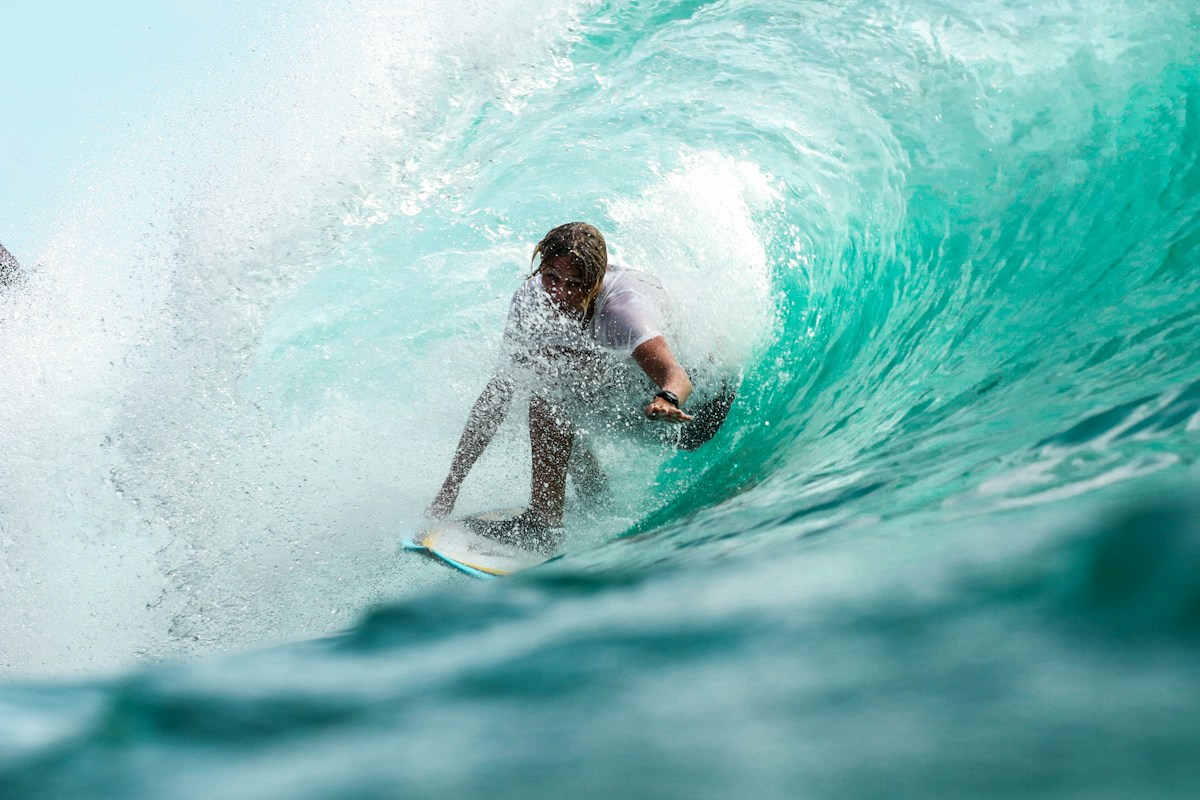
PlaceKuta Beach: where Bali surfing began
Kuta Beach is where surfing began in Bali: on a small day the soft, sandy bottom is perfect for learning to stand up, with dozens of board rental shacks and surf schools lining the sand. The catch is the crowd — the lineup can be a zoo, so go early and stick to the inside section near the beach if you're a beginner.
FigureSurfing came to Bali in the 1930s
Surfing arrived in Bali in the 1930s with early travellers, but the boom came in the 1970s, when Kuta's beach breaks became a hippy-era legend. By 2025, surfing was estimated to be worth over USD 400 million a year to the island's economy, making it Bali's biggest water-sport draw.
PlacePadang Padang: Bali's famous reef break
On the south-west coast, Padang Padang's left-hander over a shallow reef is rated one of Asia's best waves, while the same beach's inside section is a gentle learner spot. Its right-hander on the northern end is fun and less crowded. Come at mid-tide on a south swell for the classic session.
PlaceUluwatu: the classic reef breaks
Uluwatu is Bali's most famous surf spot: a series of reef breaks — The Peak, Racetrack, Outside Corner and Temples — that can handle swell from chest-high to double overhead. Access is down a cliff staircase to the cave at the base, and the warungs above the cliff are part of the experience. Best on a south-west swell at mid to high tide.
FigureUluwatu's cliffs tower 70 metres
The cliffs at Uluwatu rise around 70 metres above the surf, with a famous temple perched on top. The breaks below are named after the features you can see from the cliff: the Peak, Racetracks, Outside Corner and Temples. Watching the sunset from the clifftop warungs after a session is a Bali rite of passage.
PlaceBingin: a short, punchy left
Bingin is a short, punchy left-hander over shallow reef, tucked below the cliffs near Uluwatu. It's a favourite with intermediate surfers who want a fast, hollow wave without the Uluwatu crowds. Access is down a steep set of stairs, and the warungs at the bottom make it a great place to spend a whole day.
PlaceDreamland: a long right for intermediates
Dreamland (New Kuta Beach) offers a long, fun right-hander over sand and reef, with a wide beach that suits families and learners on small days. It's named after the resort development above it, and the beach has cafes and loungers for non-surfers. Good on a south swell at mid-tide.
PlaceBatu Bolong, Canggu: the learner's beach
Canggu's Batu Bolong is a mellow beach break with a soft sand bottom, perfect for beginners and longboarders. The lineup is friendly, the vibe is relaxed, and the beach clubs behind it make it easy to spend a whole day there. It's one of the best places in Bali to take your first surf lesson.
PlaceEcho Beach: Canggu's intermediate step-up
Echo Beach (Pantai Batu Mejan) in Canggu is a step up from Batu Bolong: a reef and sand mix that produces faster, punchier waves for intermediates. The black sand beach is lined with cafes and the sunset sessions here are legendary. Watch the rocks at low tide.
PlaceKeramas: the east coast's pro wave
Keramas on the east coast is Bali's best right-hander: a fast, hollow wave over a black-sand reef that hosts the World Surf League's Bali Pro. It's an advanced wave — powerful, shallow and unforgiving — but watching the pros from the cliffside warungs is a spectacle in itself. Best on an east swell with an offshore wind.
TipFirst lesson? Start at Kuta or Batu Bolong
For a first lesson, Kuta, Seminyak and Batu Bolong are the go-to spots: soft sand, gentle waves and a surf school on every corner. A group lesson typically costs IDR 250,000–350,000 for two hours including board and instructor, while a private lesson runs IDR 450,000–700,000. Book the morning session for the cleanest conditions.
FigureRenting a board costs around IDR 50,000–100,000
Board rental on the beach runs about IDR 50,000–100,000 for a couple of hours, or IDR 100,000–200,000 for a full day, depending on the board and the beach. Soft-top foam boards are the best choice for beginners — they're forgiving, floaty and won't hurt you (or anyone else) when you fall. Always check the board for dings before you pay.
FactDry season is prime surf season
The dry season (April to October) is prime surf season in Bali: consistent south swells, offshore winds and clean conditions, especially on the west coast. The wet season (November to March) brings bigger swells to the east coast — Keramas and Nusa Dua come alive — but also onshore winds and rain. There's surf year-round; the question is which coast.
FactThe swells come from the Southern Ocean
Bali's west coast faces the Indian Ocean, so it picks up the big south swells that roll up from the Southern Ocean — the same swells that hit Western Australia. Swell height is measured in feet: a 3–4 ft day is fun and manageable, while 6 ft+ at Uluwatu is serious. Check the forecast before you go; Magic Seaweed and Surfline both cover Bali well.
TipTides decide whether the reef breaks work
Tides matter enormously in Bali. Many reef breaks only work at mid to high tide — at low tide the reef is dangerously shallow. Uluwatu, Padang Padang and Bingin all need a decent tide, while the beach breaks at Kuta and Canggu are more forgiving. Check the tide chart every morning; the locals do.
TipReef cuts: Bali's most common surf injury
Reef cuts are the most common Bali surf injury: the coral and volcanic rock under the waves is sharp, and a fall at low tide can leave you with cuts that take weeks to heal. Wear reef booties if you're surfing reef breaks, and carry a small first-aid kit with antiseptic. If you get a deep cut, see a clinic the same day — reef infections are no joke.
TipSurf etiquette: who has right of way
Surf etiquette is the unwritten law of the lineup: the surfer closest to the peak (the breaking part of the wave) has right of way, and dropping in on someone else's wave is the fastest way to make enemies. Don't paddle straight through the lineup, wait your turn, and apologise if you get in the way. At crowded spots like Canggu, patience is a survival skill.
FactThe Bali Pro put Keramas on the world map
The 2018 Bali Pro at Keramas was a landmark: it was the first World Surf League Championship Tour event held in Bali, and it put the east coast on the world surf map. Italo Ferreira won the men's event. The WSL has returned to Bali several times since, and Keramas remains the island's pro-stage wave.
TipRip currents: know what to do
Rip currents are the real danger at Bali's beaches, especially Kuta, Seminyak and Canggu during the wet season. If you're caught in one, don't fight it — float, stay calm and swim parallel to the beach until you're out of the current, then ride the waves in. Never swim or surf alone at an unfamiliar beach, and respect the red flags.
PlaceMedewi: Bali's longest wave
Medewi on the west coast is Bali's longest wave: a mellow, peeling left-hander that can run for hundreds of metres on a good swell. It's a favourite with longboarders and intermediate surfers, and the black-sand beach has a sleepy, old-Bali feel. It's about a 2.5-hour drive from Kuta, so it's best as an overnight trip.
FigureMedewi rides can run 300 metres
On a good swell at Medewi, a single ride can last 30 seconds or more and cover 300 metres or longer — one of the longest rides in Indonesia. The wave is gentle enough for intermediates but the length makes it a bucket-list wave for travelling surfers. The point break needs a south-west swell and a mid tide.
PlaceNusa Lembongan: island reef breaks
Nusa Lembongan, a 30-minute fast boat from Sanur, has three quality reef breaks — Shipwrecks, Lacerations and Playgrounds — that are less crowded than the mainland. Playgrounds is the friendliest, good for intermediates, while Shipwrecks is a fast, hollow right for advanced surfers. The island's surf camps make it easy to base yourself there for a few days.
PlaceSerangan: the Sanur reef break
Serangan (Turtle Island), just off Sanur, has a consistent right-hander that works on a south swell and is sheltered from the wind. It's reached by a short boat ride from Sanur and is a good option when the west coast is blown out. The wave breaks over reef, so mind the tide.
PlaceBalian: a mellow river-mouth break
Balian, on the west coast about 1.5 hours from Kuta, is a river-mouth beach break with a mellow left and right that suits beginners and longboarders. The village has a laid-back surf-camp scene and the sunsets are superb. It's a good stop on the way to Medewi.
PlaceGreen Bowl: a hidden hollow right
Green Bowl (Pantai Green Bowl) below the cliffs near Ungasan is a secluded beach with a hollow right-hander over reef, plus a cave at the southern end. It's a quiet spot, far from the crowds, with a steep staircase down. Best on a south swell at mid to high tide — and bring water, as there are no shops on the beach.
PlaceThe Bukit: Bali's surf heartland
The Bukit Peninsula is Bali's surf heartland, home to Uluwatu, Padang Padang, Bingin, Dreamland, Impossibles and Balangan — a dozen quality breaks within a 20-minute drive of each other. The limestone cliffs, white sand and turquoise water make it the most dramatic surf coast on the island. Base yourself in Uluwatu or Bingin for a surf trip.
PlaceImpossibles: the long, fast left
Impossibles, between Bingin and Padang Padang, is a long, fast left-hander that lives up to its name on a big swell — the sections link up so quickly that only the best surfers make the whole wave. On a small day it's a fun, rippable wall. It's an intermediate-to-advanced wave, best at mid-tide on a south swell.
PlaceBalangan: a beautiful bay break
Balangan Beach on the Bukit's west side is a beautiful white-sand bay with a fun left-hander over reef, popular with intermediates and longboarders. The clifftop warungs have a great view of the lineup, and the beach is quieter than Uluwatu. Best at mid to high tide on a south swell.
TipSurfing lingo: ombak, papan, pantai
Surfing in Bali has its own vocabulary: "ombak" is the Indonesian word for wave, "papan selancar" is a surfboard, and "pantai" is beach. You'll hear "bagus" (good) shouted across the lineup when a set arrives, and "hati-hati" (be careful) when the reef is shallow. Knowing a few words earns smiles from the local surfers.
TipBringing your own board
If you're bringing your own board, most airlines charge a surfboard fee (typically USD 50–150 each way) and boards travel best in a padded bag with the fins removed. Alternatively, Bali has excellent board rental and second-hand shops in Kuta and Canggu, so many travellers just rent. If you buy a board in Bali, haggle — the first price is never the final price.
TipWords to know
ombak — wave;
selancar — to surf;
papan selancar — surfboard;
pantai — beach;
laut — sea / ocean;
pasir — sand;
karang — coral / reef;
berselancar — surfing;
peselancar — surfer;
ombak besar — big wave;
ombak kecil — small wave;
arus — current;
pasang — high tide;
surut — low tide;
angin — wind;
cuaca — weather;
bagus — good;
hebat — great / awesome;
hati-hati — be careful;
ayo — let's go / come on;
terima kasih — thank you;
maaf — sorry
See also: related sets
Surfing pairs with the beaches it happens on — the Bukit's bays in Beaches, the boat trip to Lembongan's breaks in Boats, and the island's reef life in Diving.