PlaceSekumpul: Bali's most spectacular waterfall cluster
Near Sekumpul village in the hills south-east of Singaraja, six or seven falls pour into one jungle gorge, the main pair dropping side by side. The cold pool at the base is swimmable, but reaching it means a few hundred steep steps and a river crossing, so allow two to four hours on site. It is about an hour inland from Lovina and two to three hours from Ubud.
FigureSekumpul drops around 80 metres
The main Sekumpul falls are usually quoted at around 80 metres high, making them among the tallest in Bali. No official measurement exists and figures up to 130 metres circulate online, so treat 80 metres as the commonly accepted estimate. For scale, that is roughly the height of a 25-storey building.
FactSekumpul means 'a cluster' in Indonesian
The name is literal: this is not one waterfall but a gathering of falls fed by different sources in the same valley. One of the main pair is river-fed and turns brown after rain, while its neighbour is spring-fed and stays clear. The three falls a short walk away on the Lemukih side are known to visitors as the Fiji falls.
TipAt Sekumpul, a local guide is compulsory
Beyond the viewpoint at Sekumpul you must take a village guide, and the fee is bundled into the trek tickets: around IDR 125,000 to 150,000 for the main falls, more for the long trek adding the Fiji falls. Buy only at the official booth by the 'Welcome to Sekumpul' sign and ignore touts who flag down cars on the approach roads. The same guide rule applies for slides and jumps at Aling-Aling.
PlaceAling-Aling: natural slides and cliff jumps
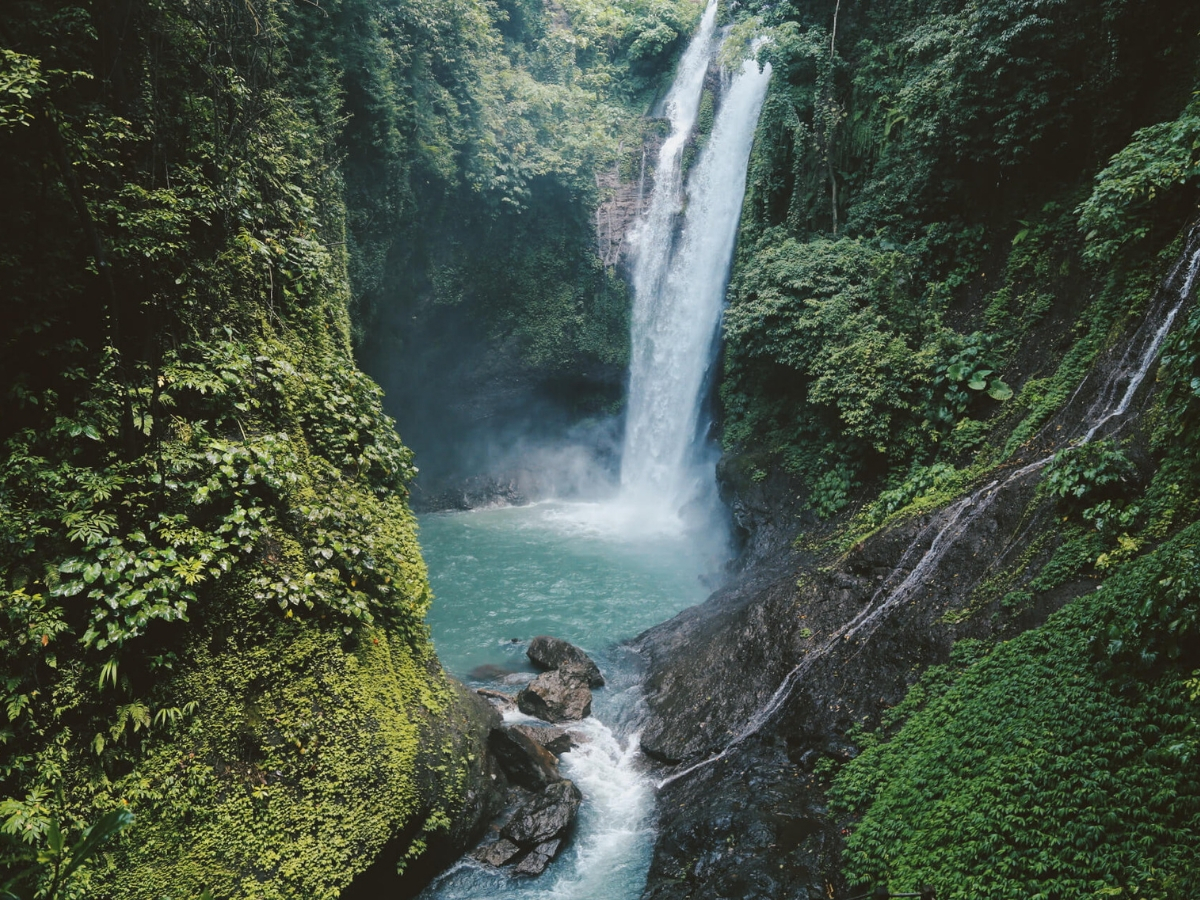
In Sambangan village near Singaraja, the 35-metre twin Aling-Aling fall is sacred and for viewing only. The fun happens at the smaller falls upstream, Kroya, Kembar and Pucuk, where guides supervise natural rock slides and cliff jumps into deep pools. Entry is around IDR 20,000, with guided activity packages from around IDR 125,000.
FigureAling-Aling's jumps come in 5, 10 and 15 metres
The cliff jumps at the Kroya and Kembar falls upstream of Aling-Aling are graded at roughly 5, 10 and 15 metres, so nervous first-timers can start low and work up. There are also two natural rock slides worn smooth by the river. Guides check pool depth and supervise every jump, which is why the activity packages are mandatory.
FactMany Balinese falls are sacred places
Water from springs and falls is holy in Balinese Hinduism, used for melukat purification ceremonies and temple rituals, and you will often see small shrines and offerings near the water. The main Aling-Aling fall is sacred, which is why swimming is forbidden there. Dress modestly near shrines, never climb on offerings, and follow any local rules about entering the water.
PlaceGitgit: the classic easy-access northern fall
Gitgit sits just off the main Bedugul to Singaraja road and is reached by a paved, mostly gentle 10 to 15 minute walk lined with coffee and souvenir stalls. The single drop is powerful year-round and the setting is a lush jungle gorge. It makes an easy first waterfall stop on any north Bali day trip.
FigureGitgit and Aling-Aling both stand about 35 metres
Two of the north's best-known falls share a similar scale: Gitgit's single drop and Aling-Aling's twin cascade are each around 35 metres high. That is less than half the height of Sekumpul's main falls, which is why Sekumpul feels so much grander in person. Banyumala's main fall is in the same league at around 36 metres.
PlaceBanyumala Twin: the north's best swimming fall
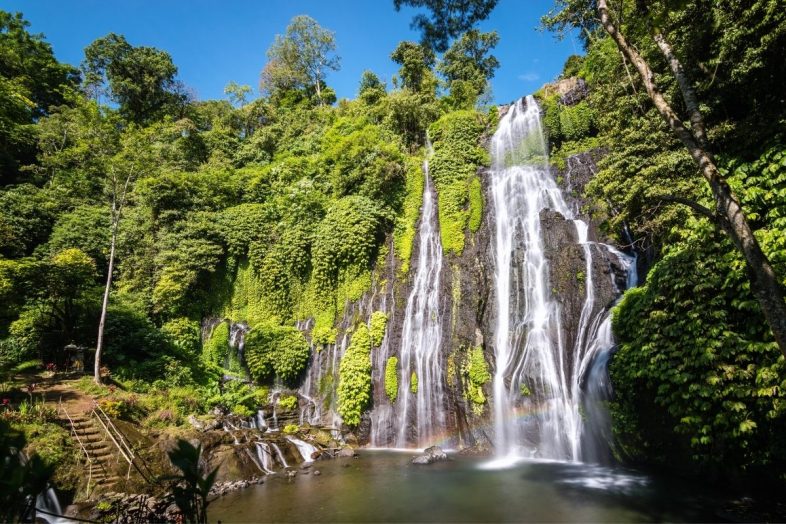
Below Wanagiri village near Munduk, two streams spill side by side over a fern-covered cliff into a wide, clear pool that is waist to chest deep. The walk down takes 10 to 20 minutes on concrete steps and entry is around IDR 50,000, with children under 10 usually free. It has a Sekumpul-like setting with a fraction of the visitors.
PlaceMunduk: four waterfalls on one highland trail
The mountain village of Munduk, at around 800 metres in the Buleleng highlands, links four falls through coffee and clove gardens: Red Coral, Melanting, Labuan Kebo and Golden Valley. Each charges a small separate fee, generally around IDR 20,000, and the full trek takes four hours or more. The air is cool, the falls are quiet, and it combines well with Banyumala nearby.
PlaceLeke Leke: a tall ribbon in the jungle
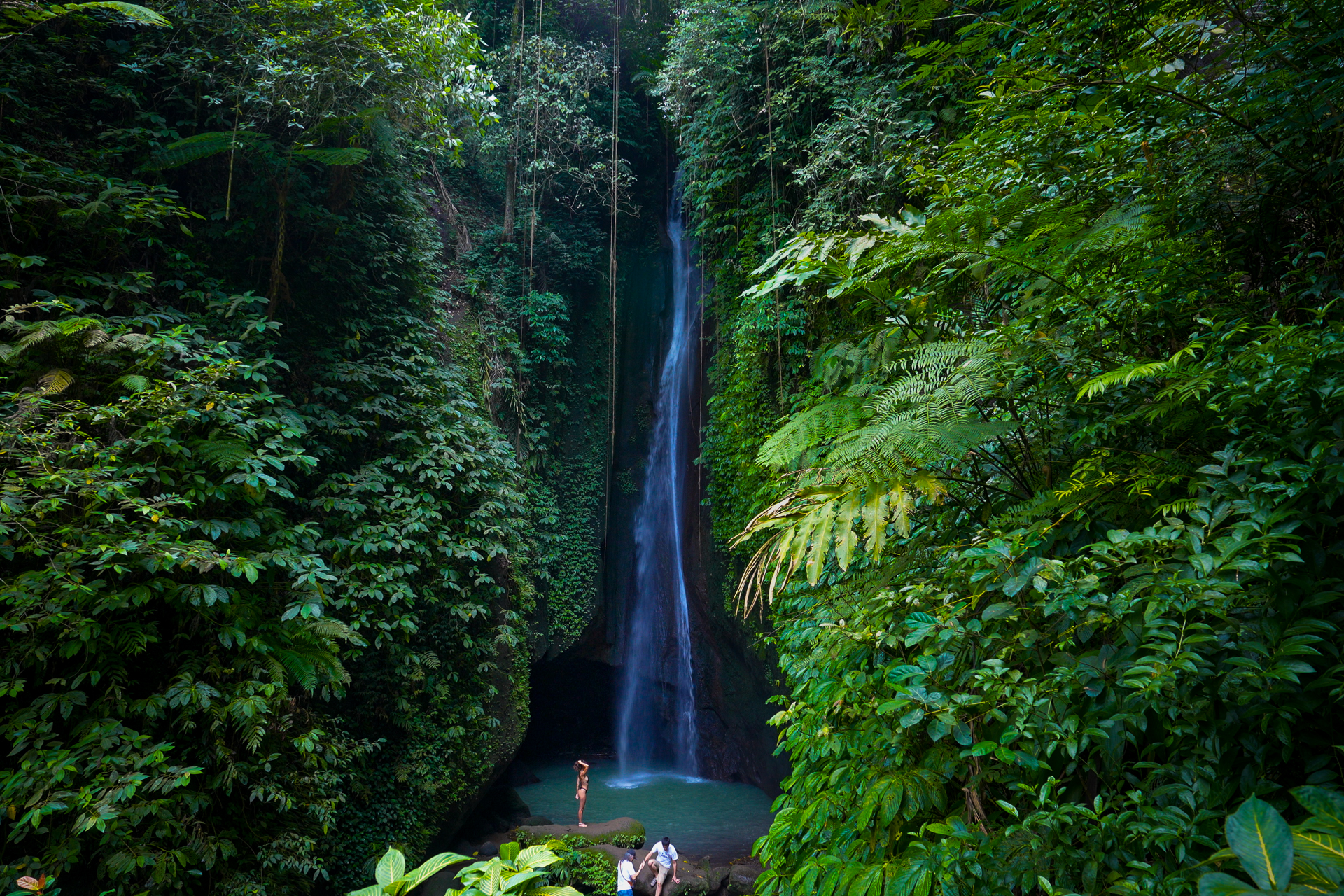
On the road between Ubud and Bedugul in Tabanan, Leke Leke drops as a tall, narrow curtain of around 30 metres into a small pool in a green ravine. The descent takes 15 to 20 minutes and involves roughly 400 small steps, and entry is around IDR 50,000. The pool is shallow, better for cooling off and photos than for a real swim.
PlaceNungnung: Bali's most powerful single drop
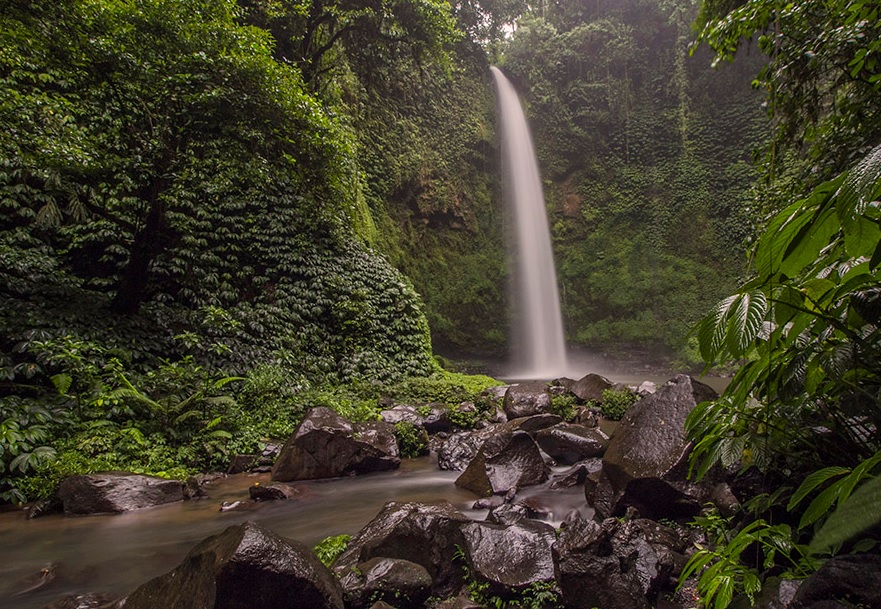
At Plaga in the Badung highlands, about an hour north of Ubud, Nungnung thunders around 50 metres down a jungle gorge in one heavy sheet — many visitors rate it Bali's most powerful waterfall. Reaching the base means descending roughly 500 concrete steps, and the climb back up is a genuine workout. Entry is around IDR 20,000, and you can swim in the pool at the base, keeping clear of the fall line itself.
PlaceYeh Mampeh: the 'flying water' of Les
Yeh Mampeh — its name means 'flying water' — drops around 30 metres into a shaded pool near Les village, Tejakula, on Bali's quiet north-east coast. A forest path of about 10 to 15 minutes leads in, swimming is allowed, and crowds are rare this far from the south. Entry for foreign visitors is around IDR 20,000 to 30,000; it pairs well with the Amed and Tulamben coast nearby.
PlaceTegenungan: the closest big fall to Ubud
At Kemenuh village, about 20 to 30 minutes south of Ubud, Tegenungan is a wide, powerful fall on the Petanu River with a large pool where swimming is allowed away from the falling water. Entry is around IDR 30,000 and the descent is roughly 170 to 200 steps. It is the easiest waterfall to add to an Ubud day, but expect crowds by late morning.
FactBlangsinga: Tegenungan by its other name
If a driver or map offers you Blangsinga Waterfall, it is not a second fall: Blangsinga and Tegenungan are two names for the same cascade, taken from the villages on opposite banks of the Petanu River. Each village runs its own entrance — the Blangsinga side, at Blahbatuh, views the falls from the opposite bank. Knowing this saves you paying twice for the same waterfall on two different stops.
PlaceTibumana: a curtain of water you can swim under
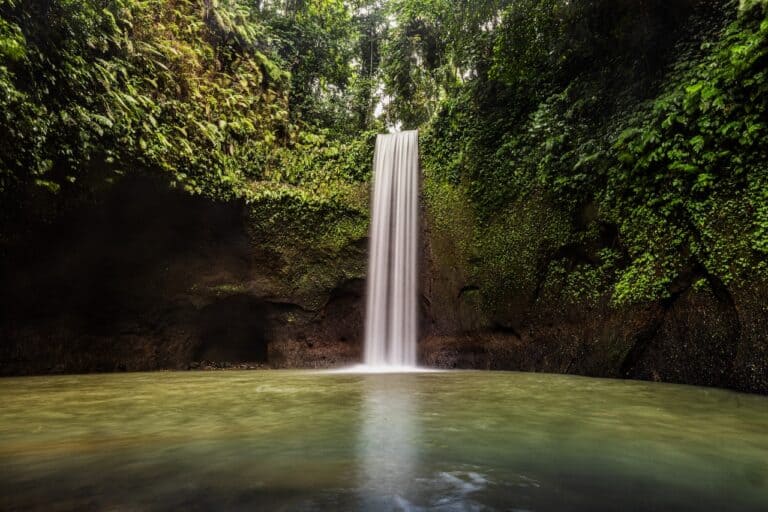
Hidden in a mossy ravine near Apuan village in Bangli, about 40 minutes east of Ubud, Tibumana falls as a single even curtain into a calm, clear pool. The walk in is an easy 10 to 15 minutes through rice fields and palm groves, and entry is around IDR 15,000 to 25,000. It is one of the best easy swim stops near Ubud.
PlaceTukad Cepung: the waterfall inside a canyon cave
Near Tembuku in Bangli, the river drops through an opening in a canyon roof, and on sunny mornings shafts of light beam down through the mist. Getting in means steep steps then wading ankle-deep along the canyon floor for about 15 to 20 minutes; the water is for wading, not swimming. Entry is around IDR 30,000 and it pairs easily with nearby Tibumana.
PlaceKanto Lampo: the photographer's stepped cascade
At Beng village in Gianyar, about 30 minutes from Ubud, water fans down a wide, terraced rock face in thin sheets rather than a single drop. You wade into the shallow stream and can stand within the cascade itself, which is why it is such a favourite for photos. Entry is around IDR 25,000 and the walk down is only five to ten minutes, but go early to beat the photo queues.
PlaceSumampan: the waterfall that irrigation built
Sumampan, in Kemenuh village about 20 minutes south of Ubud, is a waterfall with an unusual origin: leaking irrigation channels gradually wore through the rock, spreading the flow across a broad cliff face in soft streams rather than one drop. The cascade is only around 10 to 15 metres high, but the cliff and river rocks are covered with faces and Hindu figures carved from 2018 by local artist Nyoman Retana. Entry is around IDR 20,000, cash only.
PlaceUma Anyar: Kemenuh's quiet local fall
Uma Anyar is a small, community-run waterfall in Kemenuh village, about 20 minutes from central Ubud, and still largely off the tourist trail. A short, easy walk of five to ten minutes leads to a natural pool framed by rice terraces and forest — simple, peaceful and rarely crowded. Entry is around IDR 20,000, cash only, and it combines easily with neighbours Tegenungan and Sumampan.
FigureStep counts: Tegenungan 200, Leke Leke 400
The walk back up is the workout at most Bali falls. Tegenungan's staircase is around 170 to 200 steps, Leke Leke's path has roughly 400 small steps, and Sekumpul's climb out involves a few hundred steep steps plus a river crossing. None need special fitness, but all feel harder in midday heat and humidity.
FactWhy most big falls are in the north
Bali's volcanic mountain spine runs east-west across the island, and the northern slopes are steep and short, so rivers plunge quickly toward the Java Sea. The Buleleng highlands around Munduk, Sambangan and Sekumpul also catch heavy rainfall. That combination of height, slope and water is why the north holds most of the island's tall waterfalls.
FactVolcanic rock is why the falls exist
Bali's waterfalls form where rivers cross hard volcanic rock, mostly old lava flows and basalt, that resists erosion while softer rock around it wears away. The result is a sudden cliff edge, a falling sheet of water and a plunge pool scoured out below. The same geology gives many falls their dark rock faces and natural rock shelves.
FactWet season makes falls mighty but risky
From around November to March, heavy rain swells Bali's rivers and the falls thunder at full power, often running brown with sediment. It is the most dramatic time to see them, but also when paths are slickest and swimming is most likely to be closed. In the dry season, roughly April to October, water runs clearer and pools are calmer for swimming.
FigureMost entry fees sit between IDR 15,000 and 50,000
Village-run ticket booths keep waterfall entry cheap: around IDR 15,000 to 25,000 at quieter falls like Tibumana and Kanto Lampo, and around IDR 30,000 to 50,000 at Tegenungan, Tukad Cepung, Banyumala and Leke Leke. Guided trekking sites cost more, from around IDR 125,000 per person. Fees change without notice and are almost always cash only, so carry small notes.
TipArrive before 10am for the best experience
Waterfalls are at their best in the morning: tour groups have not arrived, the light is softer for photos, and the climbs back up are cooler. At Tukad Cepung the famous sunbeams hit the canyon floor roughly between 9am and 11am, so time that one for mid-morning. By midday the popular falls near Ubud can feel crowded.
TipWear shoes that grip and can get wet
Waterfall paths mean wet concrete steps, mud, mossy rock and sometimes wading through the river itself, as at Tukad Cepung and Sekumpul. Sports sandals or trainers with real tread are ideal; thongs (flip-flops) are a sprained ankle waiting to happen. A dry bag or zip-lock pouch for your phone is worth packing too.
TipHeavy rain upstream means stay out of the water
Flash flooding is the real danger at Bali waterfalls: rain falling high in the mountains can send a surge down a gorge while the sky above you is clear. If the water suddenly rises, speeds up or turns muddy, get to high ground immediately. After heavy overnight rain, skip swimming altogether and obey any closures or roped-off areas at the site.
TipChain three or four falls into one day trip
Waterfalls cluster, so hire a driver and loop them: near Ubud, start at Tukad Cepung for the 9 to 11am light beams, swim at Tibumana, then finish at Kanto Lampo or Tegenungan. In the north, Gitgit, Aling-Aling and Sekumpul sit within a short drive of each other, and Munduk pairs with Banyumala. Bring cash in small notes, because every booth is cash only and ATMs are scarce in the hills.
TipWords to know
air — water;
air terjun — waterfall;
sungai — river;
danau — lake;
kolam — pool;
mata air — spring (of water);
tirta — holy water;
beji — sacred spring bathing place;
melukat — purification ritual in holy water;
pancuran — stone water spout;
yeh — water (Balinese);
toya — water (polite Balinese);
berenang — to swim;
mandi — to bathe;
licin — slippery;
sejuk — cool / refreshing;
tebing — cliff;
jalur — trail / path;
pemandangan — view / scenery;
hujan — rain
See also: related sets
Waterfalls lead naturally to the highland forests above them: forest birds in Birds, the endangered orchid of the twin lakes in Orchids, and the holy springs where water is sacred in Temples.