FactLayang-layang means 'letter'
The Balinese word for kite is layang-layang, a diminutive of the Sanskrit word layang, meaning 'letter'. The name captures the old belief behind the tradition: a kite is a letter flown up to the gods. That idea still shapes how Balinese people treat their kites today.
FactRare Angon, the god of wind
Kite flying in Bali honours Sang Hyang Rare Angon, the deity of wind and animals, often shown as a shepherd boy who summons the wind through a magical flute. Farmers traditionally flew kites after planting rice, asking Rare Angon for rain and a good harvest. The international kite event at Mertasari Beach is named after him.
FactKites began as thanks for the harvest
Long before there were competitions, Balinese kites were flown as an offering — a message of thanks to the Hindu gods for abundant crops, and a prayer for the next harvest. The religious meaning has never been lost: village priests still bless new kites, and construction begins on a day chosen from the Balinese Saka calendar.
FactKite season runs June to September
The dry-season south-east trade winds arrive around June and blow steadily through September, and that is kite season in Bali. The biggest kites fly in July and August, when the winds are strongest and most consistent. You will still see small kites over rice fields and beaches all year round.
FactEvery kite carries its maker's spirit
In Balinese belief, every kite has a spirit that comes from its maker — the builder shares something of himself with the kite as he works. That is why a kite is treated with respect: its carved head is shaded from the sun at the field, and a kite that falls to the ground must be caught in the air, never allowed to touch the earth.
FigureThe first official festival was in 1978
Kite flying was a village pastime for centuries, but the organised Bali Kite Festival began in 1978 at Padang Galak and Mertasari beaches in Sanur, when the provincial government set out to preserve the tradition. It has run almost every year since, and by the 1980s and 1990s it had become an international competition drawing flyers from around the world.
PlacePadang Galak Beach, Sanur: the home of the festival
Padang Galak Beach, at Sanur's northern end in Kesiman, East Denpasar, is the traditional home of the Bali Kite Festival. Its wide, open sand and steady offshore wind make it the island's favoured competition ground. Reach it via Jalan Padang Galak off the Denpasar–Kesiman coastal road, and entry to watch is free.
PlaceMertasari Beach hosts the international event
At Sanur's southern end, Mertasari Beach hosts the Rare Angon International Kite Festival, a separate event that ran from 23 to 26 July in 2026 with flyers from 23 countries. It is the best backup if the main festival weekend does not line up with your trip. Both beaches are an easy walk apart along Sanur's seafront promenade.
Figure1,077 kites in the air in June 2026
The scale of the festival keeps growing: the 48th edition, held on 6–7 June 2026, put around 1,077 kites into the air, flown by clubs from regencies and cities across Bali. The 2026 season also included the 5th 'Yadnya Cakra' festival at Mertasari on 18–19 July, with more than 130 teams competing for the Governor of Bali's Cup.
TipThere is no fixed date — watch the wind
The main festival lands on a single weekend somewhere between June and September and is announced only a few weeks ahead, once the wind looks right — it ran in July in 2024, September in 2025 and June in 2026. Plan around the season rather than a date, and check Bali's tourism event calendar in the months before you travel.
FactBebean: the fish kite
The bebean is shaped like a fish, its name coming from the Balinese word be, meaning fish. It symbolises prosperity and the abundance of the sea, and its broad, stable shape makes it the easiest of the three traditional kites to fly. It is usually the largest kite in the sky, and the crowd favourite.
FigureA bebean can be 10 to 15 metres long
Competition bebean kites are enormous: around 4 metres wide and up to 10 metres long, with the most famous example — the Meranggi family's legendary fish kite — measuring 15 metres long with a 10-metre wingspan. Its tail alone stretches around 150 metres and the whole kite weighs roughly 80 kilograms.
FactJanggan: the dragon with the endless tail
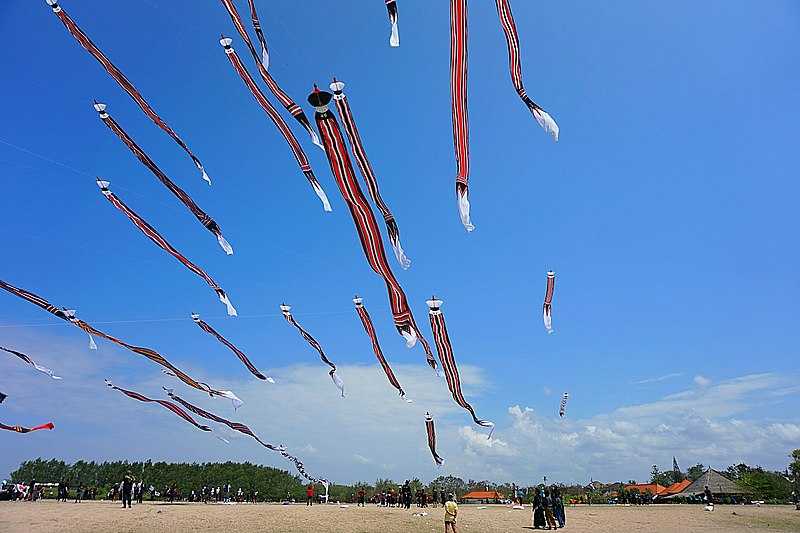
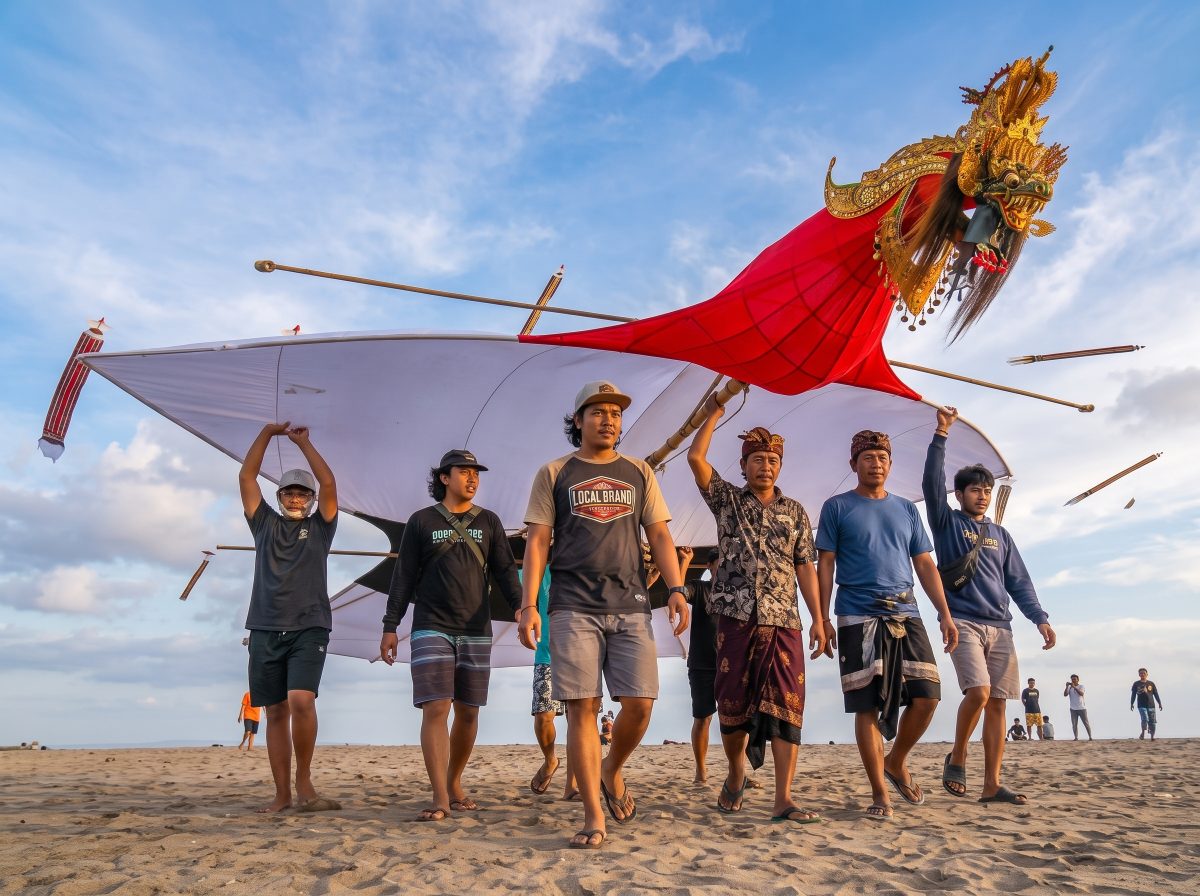
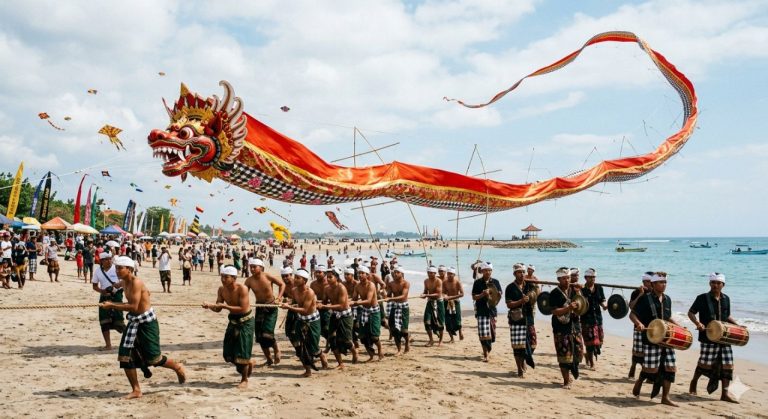
The janggan is a mythical bird or dragon with a crowned, carved head — the tapel, carved from light pule wood — and a long ribbon tail called a kedeber. It honours Naga Basuki, the mythological dragon king, and is regarded as the most sacred of the three traditional kites, holding the balance between the seen and unseen worlds.
FigureA janggan tail can run past 100 metres
The janggan's tail is its glory: typically 20 to 22 times the wingspan, so a kite around 7 metres across trails a tail of well over 100 metres — some famous examples reach around 150 to 200 metres long and 2 metres wide. The whole flying piece can weigh up to around 400 kilograms, which is why it takes a whole team to hold it.
FactPecukan: the leaf, and the hardest to fly
The pecukan is shaped like an enormous arched leaf, and it is the most difficult of the three traditional kites to fly. Its shape is inherently unstable and will tumble unless the team reads the wind perfectly, so winning with a pecukan is the mark of a serious crew. It is the favourite of experienced flyers.
FactKreasi baru: the new creations
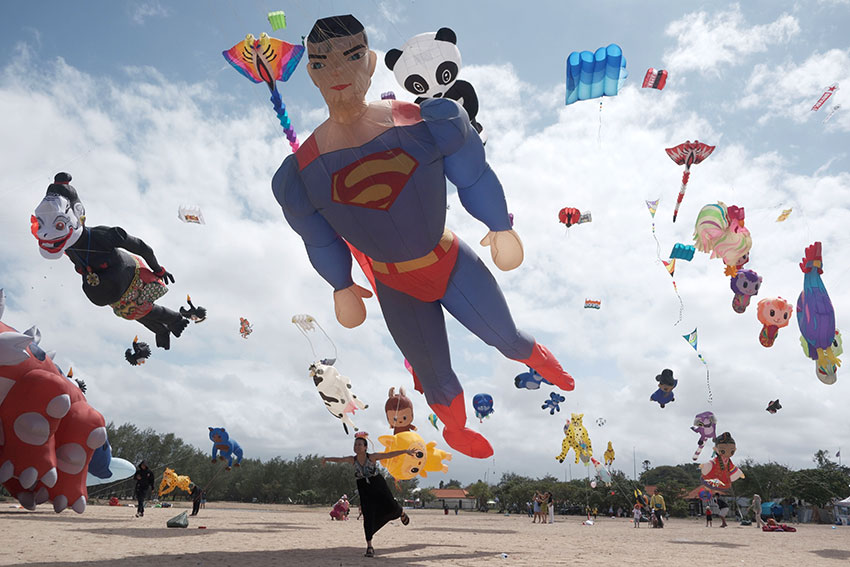
Alongside the three traditional forms runs kreasi baru — 'new creation' — where teams build whatever they can imagine: sea creatures, Hindu deities, aeroplanes, cartoon characters, motorbikes, even dollar symbols. These playful, vibrantly coloured kites are often three-dimensional and enormous, and they are the liveliest part of the festival for children.
FactRed, white and black: the tridatu colours
Traditional Balinese kites use only three colours — red, white and black — called tridatu. Red stands for Brahma the creator, white for Vishnu the preserver, and black for Shiva the destroyer. Yellow was added later, representing balance and the Dewata Nawa Sanga, the gods of the eight directions.
FactThe guwang: the kite that hums
Many traditional kites carry a guwang — a taut bamboo bow fitted across the frame that vibrates in the airstream and produces a deep humming note. Each kite carries two, one male and one female, and they should make a harmony in the air. The sound is said to please the gods and ward off evil spirits.
FactBamboo, cloth and rice paper
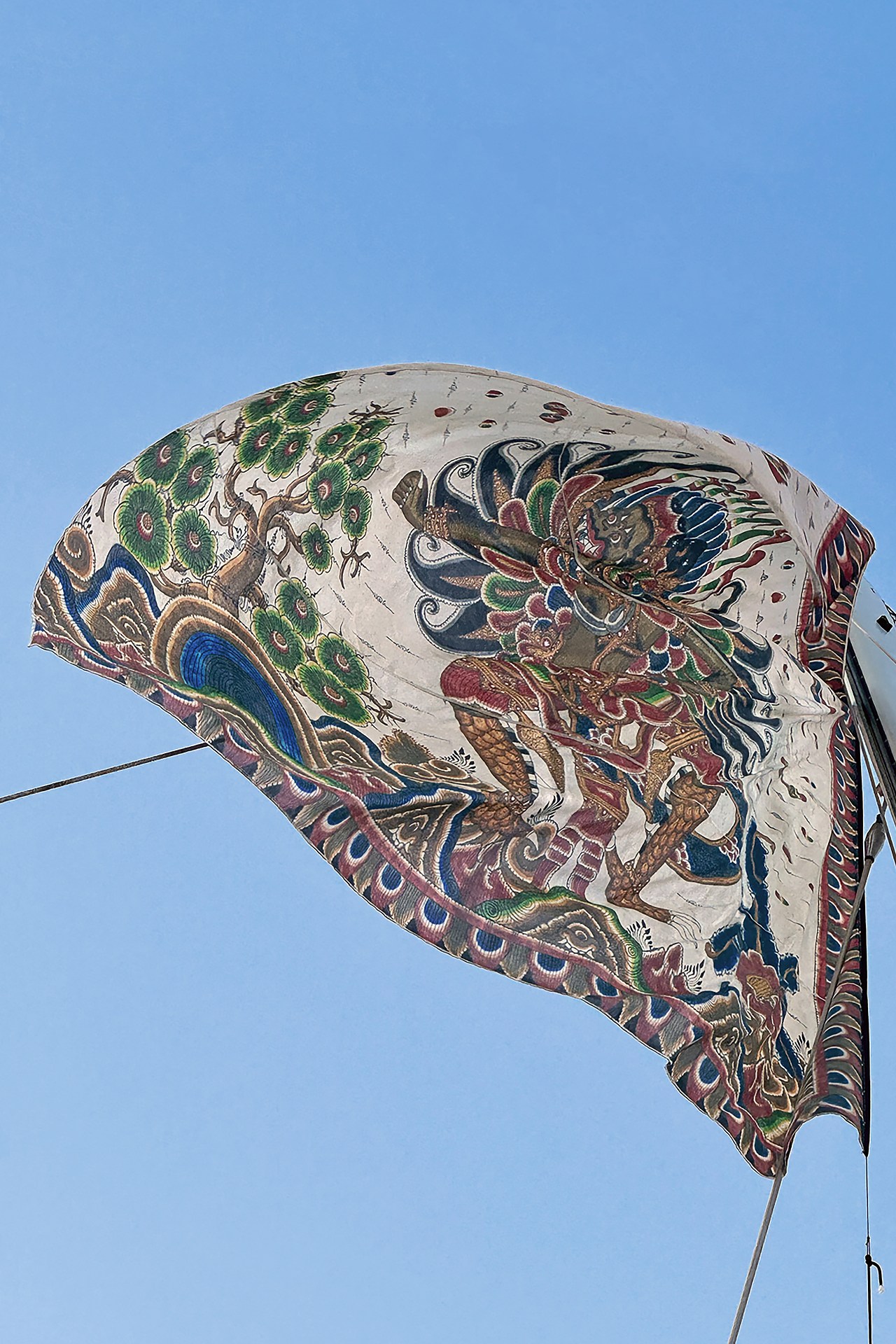
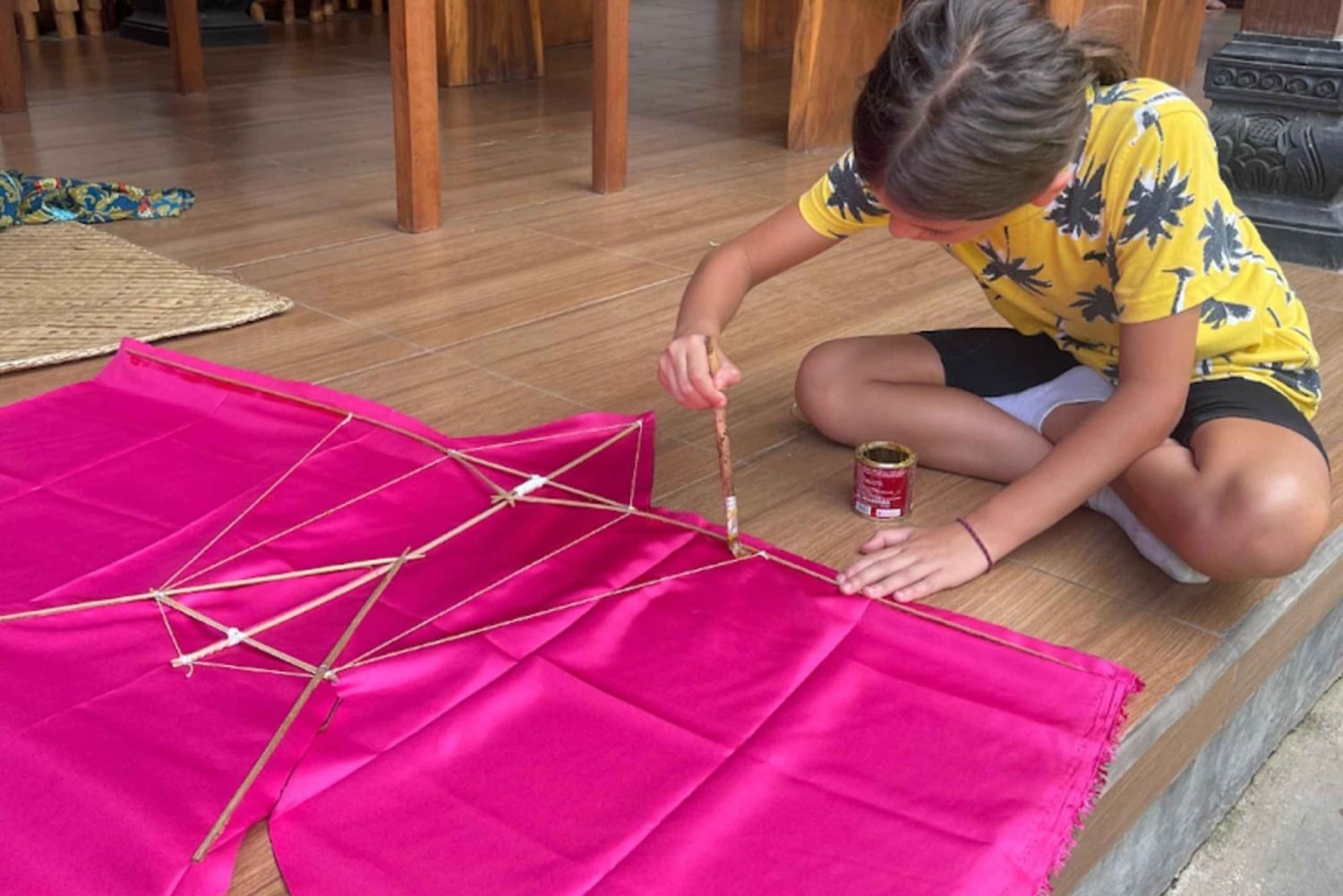
A traditional kite starts as a frame of split bamboo, lashed and bent into shape, then covered with hand-painted cloth — or, for children's kites, thin coloured rice paper called kertas minyak. Adults use sewn cotton or silk cloth and rope instead of string. Boys in Bali learn to make their first kite from their fathers, a cherished father-son activity.
FactThe Meranggi family's holy janggan
The most famous kite in Bali belongs to the Meranggi family, renowned island-wide for kite-making. Their janggan carries an ornately carved mask dating from 1956 and is the only kite in Bali considered holy. It spans around 7 metres, measures about 10 metres long, and trails a tail of around 150 metres weighing roughly 80 kilograms.
FigureKites can soar higher than 200 metres
In a good dry-season wind, Balinese kites climb to impressive heights — sometimes more than 200 metres above the beach. Competition kites are commonly 4 to 7 metres across, and the largest reach around 10 metres long before you even count the tail. From the beach, the biggest ones look like small buildings in the sky.
FactSekaa layangan: the village kite team
Each kite belongs to a sekaa layangan — a kite team from a banjar, or village community. Building a competition kite is a months-long community project: youth groups design and build it under the supervision of elders, with rituals at every stage and a priest's blessing when it is finished. Winning is a matter of village pride.
Figure70 to 100 people to launch one kite
Getting a giant kite airborne is a team effort: traditional entries need around 70 to 80 people per banjar just to get one kite off the sand, and some reports put the biggest launches at 80 to 100 people hauling ropes in unison. A gamelan orchestra often walks behind the procession, playing to build momentum for the handlers.
FactJudged on launch, design, flight and landing
Competition judging covers more than size: points are given for the best launch, the best design, the longest flight, how high the kite flies, its stability in the air, the sound of the guwang, and of course the landing. There are separate categories for janggan, bebean, pecukan and kreasi baru, plus smaller categories like the owl-shaped celupuk and the swallow-shaped kedis kandik.
FactThe Governor's Cup is the big prize
The most prestigious trophy in Balinese kite flying is the Governor of Bali's Cup, awarded at the main festival. Village teams compete fiercely for it, and a win is remembered for years. Smaller competitions run practically every weekend from June to October, organised by teams, banjars, villages and the Bali Kite Association, which published its first schedule in 1979.
PlaceMake your own kite in Sanur
You can try kite-making yourself at a workshop in Sanur, on Jalan Tukad Bilok in Sanur Kaja. In around 2 to 3 hours, friendly Balinese teachers show you the meaning of the flying creatures, supply all the materials, and guide you through making — and then flying — your own kite. It is a good pick for families, and children love it.
PlaceBuy a kite at Padang Galak or Sukawati
Stalls at Padang Galak Beach sell souvenir kites from around 30 cm up to 3 metres, ready to fly. For a wider choice, try Sukawati Art Market, a few kilometres from Celuk on the main Denpasar–Ubud road, where kite sellers sit among the textile and craft stalls. A small decorative kite makes a light, packable souvenir.
FigureA souvenir kite costs little; a class costs more
Small ready-made kites at the beach stalls are cheap — a few tens of thousands of rupiah for a small one, more for a large hand-painted model. A hands-on making workshop costs more, reflecting the materials and the teacher's time, and prices vary by studio, so ask what is included before you book. Either way, agree the price before you pay.
TipArrive at sunrise for the best flying
Competition kites launch around or shortly after sunrise to catch the best winds, so arrive early in the morning — the light is also best for photos then. The afternoon sea breeze keeps kites up for hours, and the festival runs from morning to evening, but the big launches are the morning spectacle. Bring a hat, sunscreen and water: there is little shade on the sand.
TipWatch out for the tails — and stay behind the ropes
A janggan's 100-metre tail can whip across the sand with real force when the kite takes off, so keep well clear of the launch lanes and behind any ropes or barriers. Never touch a kite being carried or launched, and keep children close during a launch. Once the kites are up, the beach is yours to wander — just look up as well as ahead.
TipWords to know
layang-layang — kite;
layangan — kite (Balinese);
bebean — fish-shaped kite;
janggan — bird-dragon kite with a very long tail;
pecukan — leaf-shaped kite;
angin — wind;
langit — sky;
terbang — to fly;
tali — string, rope;
ekor — tail;
sayap — wing;
guwang — humming sound-bow fitted to a kite;
kedeber — the janggan's long ribbon tail;
festival — festival;
lomba — competition;
pantai — beach;
awan — cloud;
matahari — sun;
tinggi — high;
sekaa — team, club
See also: related sets
Kites fly over Sanur's beaches in Beaches, are sold at the Sukawati market in Silver, and began as offerings to the gods — the temple festivals in Temples.