FactA thousand years of history on one small island
Bali's historic sites span more than a thousand years, from prehistoric burials at Gilimanuk to Bronze Age drums, 11th-century rock temples, royal palaces and the battlefields of the 1940s. Most of the oldest sites cluster in the river valleys between Ubud and Tampaksiring, so a single morning can cover a thousand years. This set moves roughly in time order, from the ancient kingdoms to the independence struggle.
Fact1343: Majapahit conquers Bali
In 1343 the East Javanese empire of Majapahit, under its chief minister Gajah Mada, defeated the last independent Balinese king at Bedulu, near today's Ubud. A Javanese-descended dynasty was installed, ruling first from Samprangan and then from Gelgel. Almost everything in this set that looks Javanese, from the tiered meru towers to the court chronicles, traces back to this conquest.
FactGelgel: the great court of the 16th century
Gelgel, near today's Klungkung, was Bali's paramount kingdom through the 16th century, at its height under King Dalem Baturenggong. When Majapahit collapsed on Java, Hindu nobles, priests and artists fled to Bali, and Gelgel became the heir of classical Javanese civilisation. The priest Dang Hyang Nirartha arrived in this period and reshaped Balinese Hinduism, founding temples including Uluwatu and Tanah Lot.
FigureNine rival kingdoms
After Gelgel broke apart in internal conflict after 1651, a new royal seat was founded at Klungkung in 1686. By the 19th century Bali was split into nine rival kingdoms: Klungkung, Karangasem, Buleleng, Jembrana, Tabanan, Badung, Gianyar, Bangli and Mengwi. The Dewa Agung of Klungkung kept the highest ritual rank, but real power was divided, which is why so many palaces and royal temples survive across the island.
PlaceBesakih: the Mother Temple
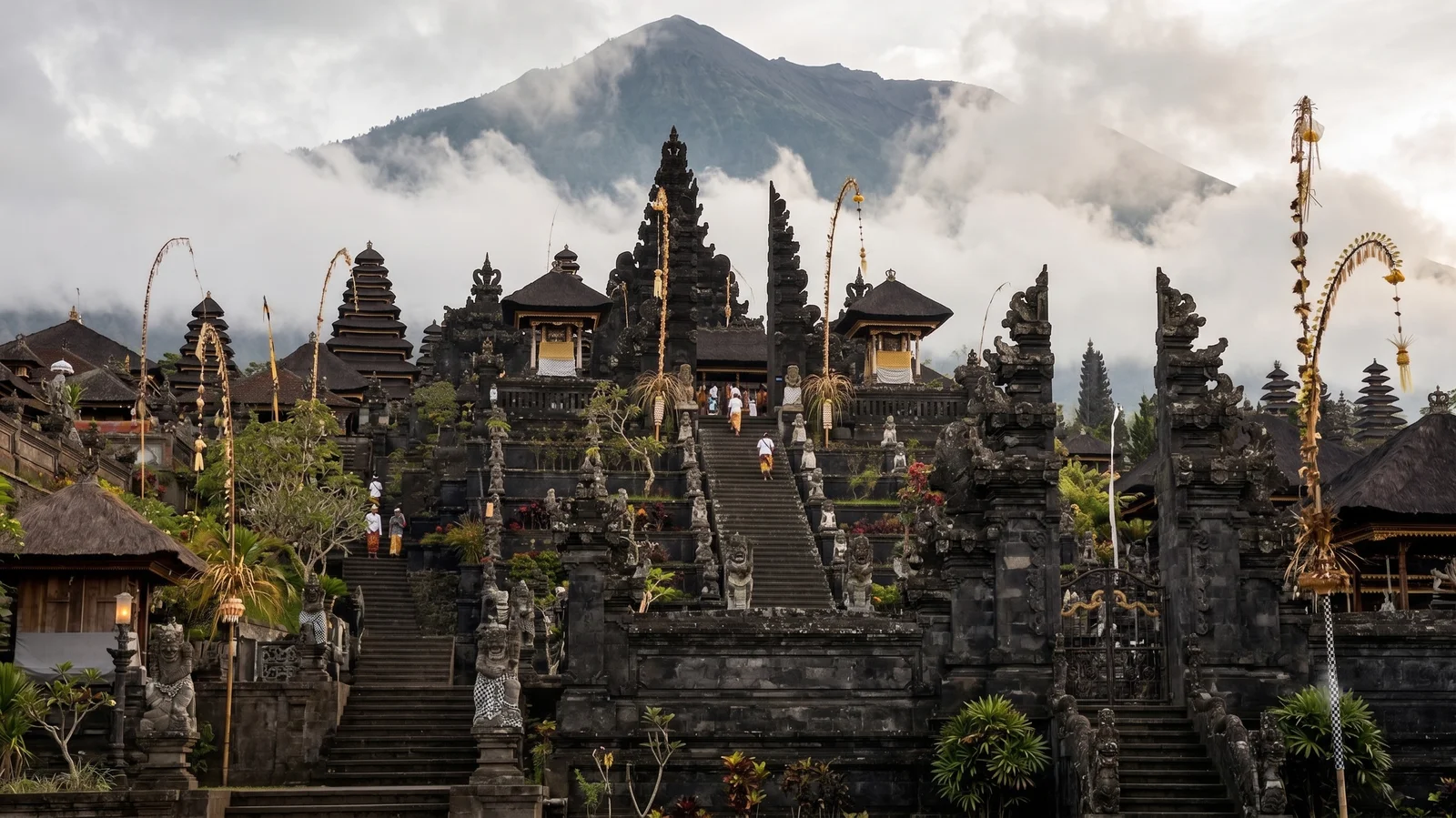
Pura Besakih, on the south-western slope of Mount Agung, is Bali's largest and holiest temple complex, with more than 80 separate shrines spread across terraced hillsides. Tradition credits its founding in the 8th century to the Javanese sage Rsi Markandeya, who is said to have buried five sacred metals as the temple's spiritual foundation. It became the central temple of the Gelgel and Klungkung courts, and every Balinese temple is oriented towards Agung. Wear a sarong and sash, and expect a guide to be offered at the gate.
FactThe lava that stopped at Besakih
When Mount Agung erupted in 1963, killing an estimated 1,100 to 1,500 people, lava flows stopped just short of Pura Besakih, which many Balinese still read as a sign of divine protection. The eruption happened during the great Eka Dasa Rudra ceremony at the temple, an event still central to Balinese memory. The same eruption destroyed the water palaces of Karangasem and reshaped the east of the island.
PlaceUluwatu: the temple on the cliff edge
Pura Luhur Uluwatu stands on the edge of a 70-metre limestone cliff at the south-western tip of the Bukit Peninsula, above the Indian Ocean. The name joins ulu, edge, with watu, rock. A small shrine stood here earlier, but the temple was greatly expanded in the 11th century by the Javanese sage Mpu Kuturan, and in the 16th century the priest Dang Hyang Nirartha added the padmasana shrines and is said to have attained moksha, spiritual liberation, on this cliff.
PlaceTanah Lot: the temple in the sea
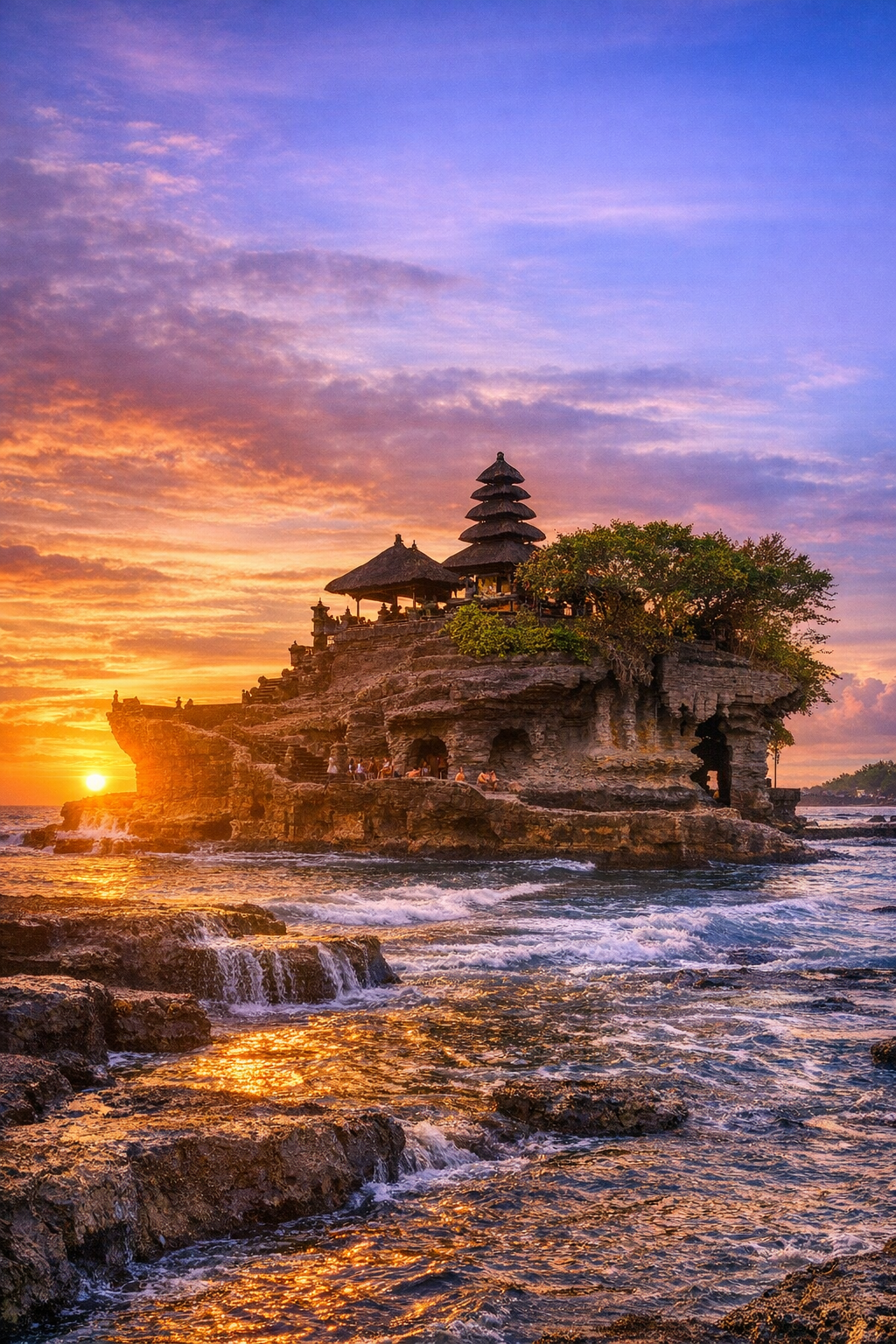
Tanah Lot is a 16th-century sea temple on an offshore rock at Beraban, on Bali's south-west coast, reached on foot at low tide. It is credited to the priest Dang Hyang Nirartha, who is said to have meditated on the rock and asked local fishermen to build a shrine to Bhatara Segara, the sea god. By the 1980s the sea had eaten so far into the rock that it threatened to collapse, and a Japanese government loan of about Rp 800 billion paid for its restoration. Entry is around IDR 75,000, and the shrine itself is for worshippers only.
PlaceTirta Empul: the holy spring of 962
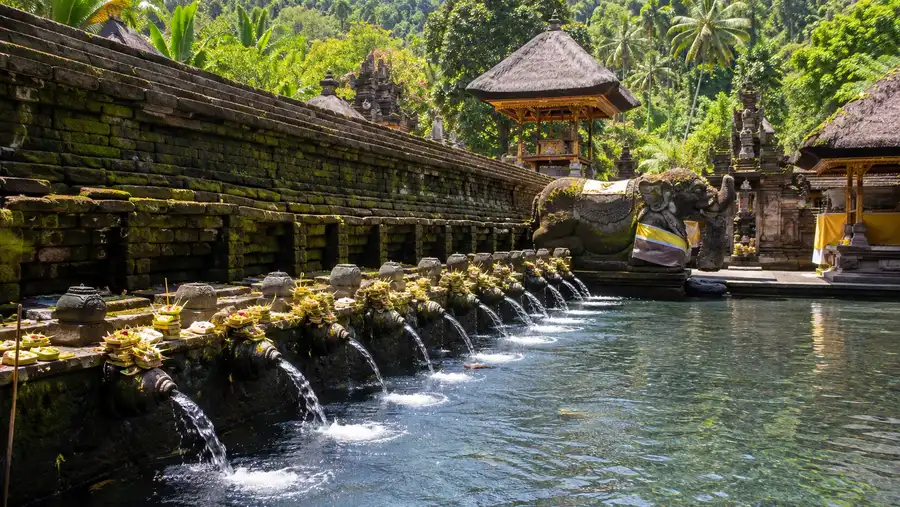
Pura Tirta Empul, at Tampaksiring near Ubud, was founded around a large natural spring in 962 AD during the Warmadewa dynasty. The temple is dedicated to Vishnu, and Balinese Hindus come to purify themselves in its bathing pools in a ritual called melukat. Legend says the god Indra struck the ground here to create a healing spring after the tyrant king Mayadenawa poisoned his army's water. The spring is also the source of the Pakerisan River. Entry is around IDR 50,000, including sarong hire.
PlaceGunung Kawi: the valley of the kings
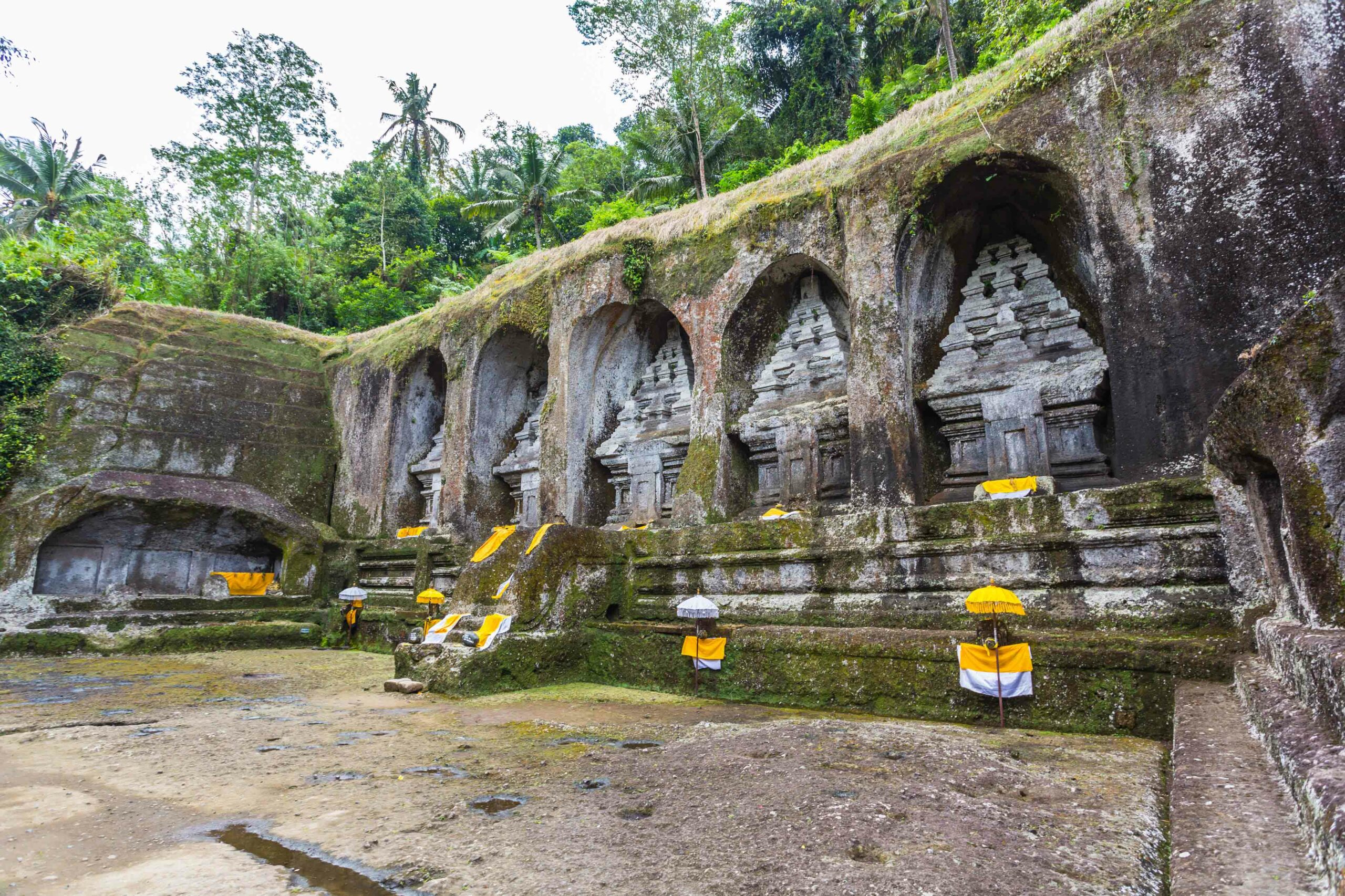
Gunung Kawi, at Tampaksiring, is an 11th-century funerary complex of ten rock-cut shrines carved into 7-metre-high niches in the cliffs on either side of the Pakerisan River. The shrines are thought to honour King Anak Wungsu of the Udayana dynasty and his family, and inscriptions in old Javanese script still survive above the false doorways. Legend says the giant Kebo Iwa carved them in a single night with his fingernails. It is about 300 steps down into the valley, and entry is around IDR 75,000.
PlaceGoa Gajah: the Elephant Cave
Goa Gajah, at Bedulu near Ubud, is a rock-cut sanctuary from around the 11th century, entered through a doorway carved as a gaping demon face meant to frighten away evil spirits. Inside are a Ganesha statue and the lingam and yoni of Shiva, while Buddhist stupas are carved into the rocks by the river below, a rare mix of two faiths in one site. Dutch archaeologists rediscovered the cave in 1923, but the bathing pools in front of it stayed buried until excavations began in 1954. Entry is around IDR 50,000.
PlaceYeh Pulu: a 14th-century snapshot of village life
A short walk through rice fields from Goa Gajah, Yeh Pulu is a limestone relief about 25 metres long and 2 metres high, carved in the 14th century. It shows everyday Balinese life: a water carrier with two jugs, maidens at doorways, a hunter riding into the forest, and two men carrying wild boars on a pole. Archaeologists still argue over its exact meaning, and it is one of the quietest historic sites near Ubud, often with almost no other visitors.
FactThe Moon of Pejeng
At Pura Penataran Sasih in the village of Pejeng stands the Moon of Pejeng, a bronze kettle drum more than 2,000 years old and described as the largest single-cast bronze drum ever found. Historians believe it was used in rice-growing rituals and is related to the Dong Son drums of northern Vietnam, though nobody knows who cast it or how it reached Bali. Legend says it is a wheel that fell from the moon's chariot, and a thief who urinated on it was killed when it exploded. The temple is one of Pejeng's three ancient temples.
PlaceUlun Danu Beratan: the temple on the lake
Pura Ulun Danu Beratan sits on the western shore of Lake Beratan in the Bedugul highlands, about 1,200 metres above sea level. It was rebuilt in 1633 or 1634 by I Gusti Agung Putu, king of Mengwi, and is dedicated to Dewi Danu, goddess of the lake, whose water feeds the rice fields and subak irrigation societies below. Its eleven-tiered meru stands on a small island, so when the lake is high the shrines seem to float. The temple once appeared on the IDR 50,000 banknote, and entry is around IDR 100,000 for foreign adults.
PlaceLempuyang: the Gate of Heaven
Pura Lempuyang is a chain of seven temples climbing the slopes of Mount Lempuyang in East Bali, believed to date from the 11th century and counted among the island's oldest and holiest sites. The famous white split gate belongs to the lowest temple, Pura Penataran Agung, and frames Mount Agung across the valley. Beyond it, about 1,700 steps climb through forest past five smaller temples to the summit temple, a 3 to 4 hour round trip. Entry is around IDR 100,000 for foreigners plus about IDR 50,000 for the shuttle, and the gate photo often means a long queue.
PlacePura Kehen: the temple of fire
Pura Kehen, at Cempaga in Bangli, was the royal temple of the Bangli kingdom and is one of Bali's oldest temples, mentioned in copper inscriptions from the 9th, 11th and 13th centuries. It was first dedicated to Hyang Api, the god of fire, and kehen means flame in Balinese. Its outer courtyard holds a banyan tree said to be at least 400 years old, with a monk's cell high in its branches, and an 11-tiered meru tower rises in the inner courtyard. Entry is around IDR 50,000, and it is usually quiet.
PlaceKerta Gosa: the court of justice
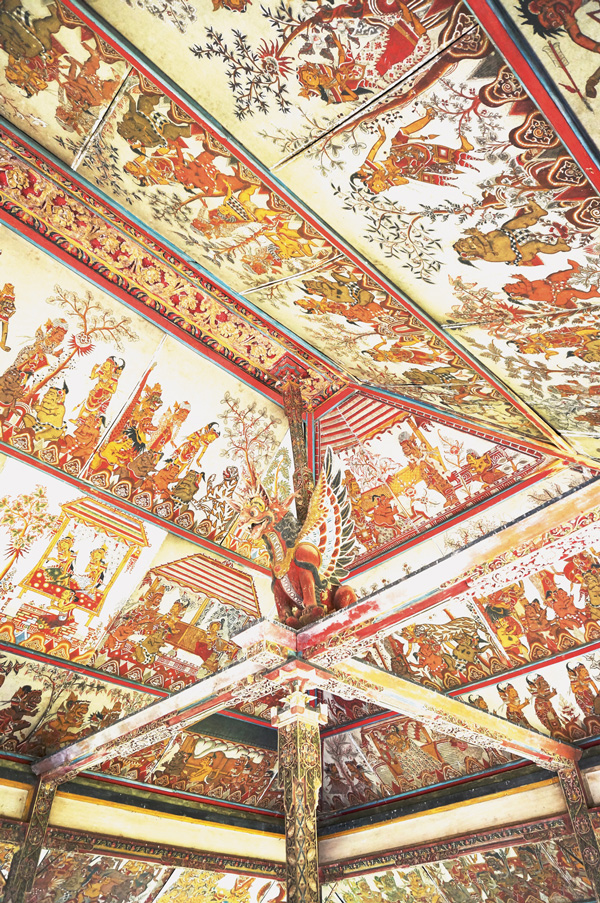
Kerta Gosa, at Semarapura in Klungkung, is what survives of the palace of the Klungkung kings, Bali's senior royal house. Built in the 17th or early 18th century by Dewa Agung Jambe I, it was the supreme court of the island, where three Brahmana priests sat as judges and unresolved cases from across Bali were heard. Its ceiling is covered in Kamasan-style paintings of the Bhima Swarga story, showing the punishments awaiting wrongdoers in the afterlife. Beside it stands Bale Kambang, the floating pavilion on its moated island.
PlaceUbud Palace: the royal house of the arts
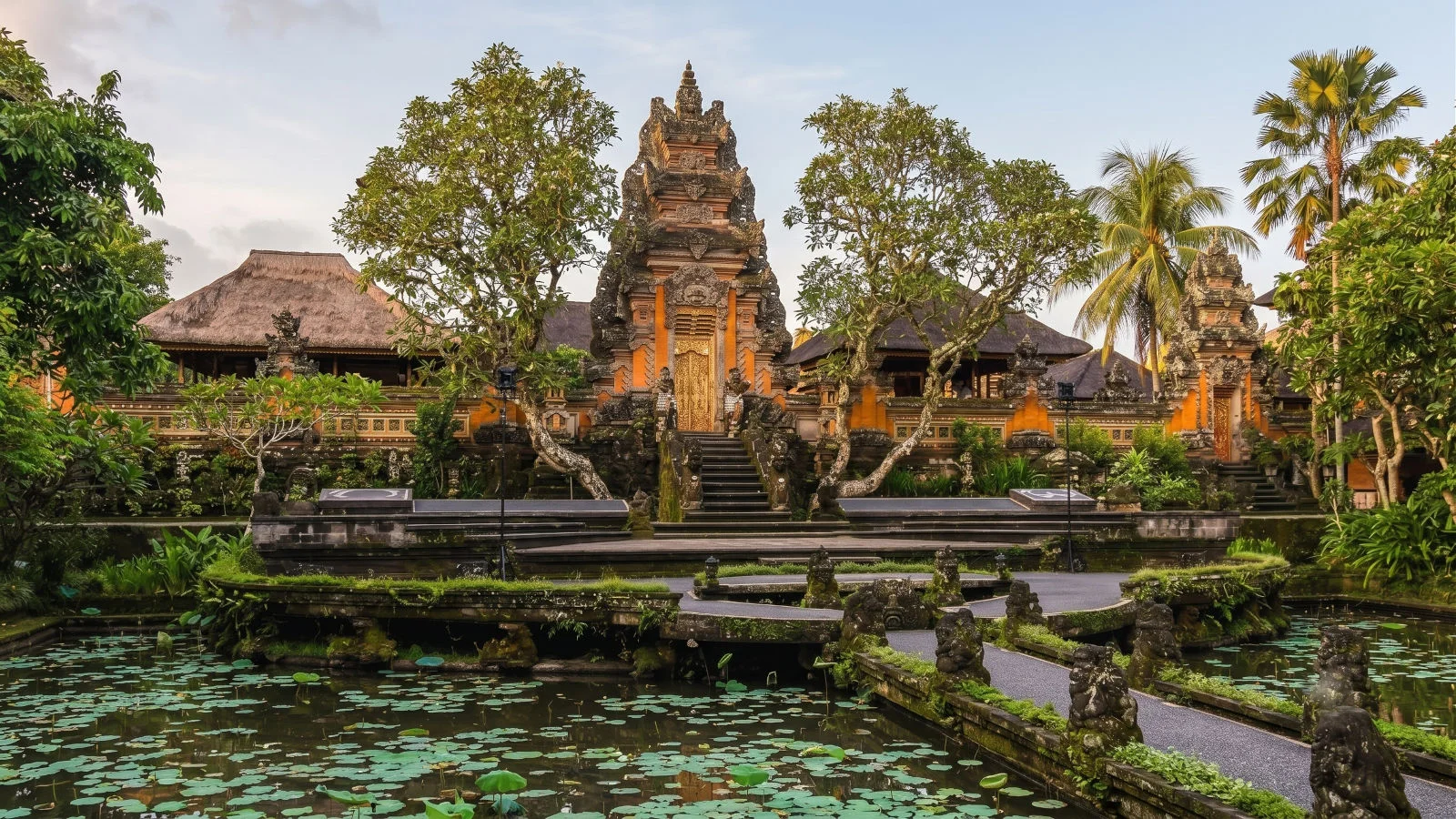
Puri Saren Agung, Ubud Palace, was built in the early 1800s under Tjokorda Putu Kandel, the first ruler of the Ubud kingdom, and largely rebuilt after an earthquake levelled much of it in 1917. It was Tjokorda Gede Agung Sukawati who invited the German painter Walter Spies and the Dutch artist Rudolf Bonnet to Ubud in the 1920s and 1930s, and in 1936 he helped found Pita Maha, the artists' cooperative that made Ubud Bali's arts capital. The royal family still lives in the inner courtyards, and the palace is free to enter by day.
PlaceTaman Ujung: the water palace
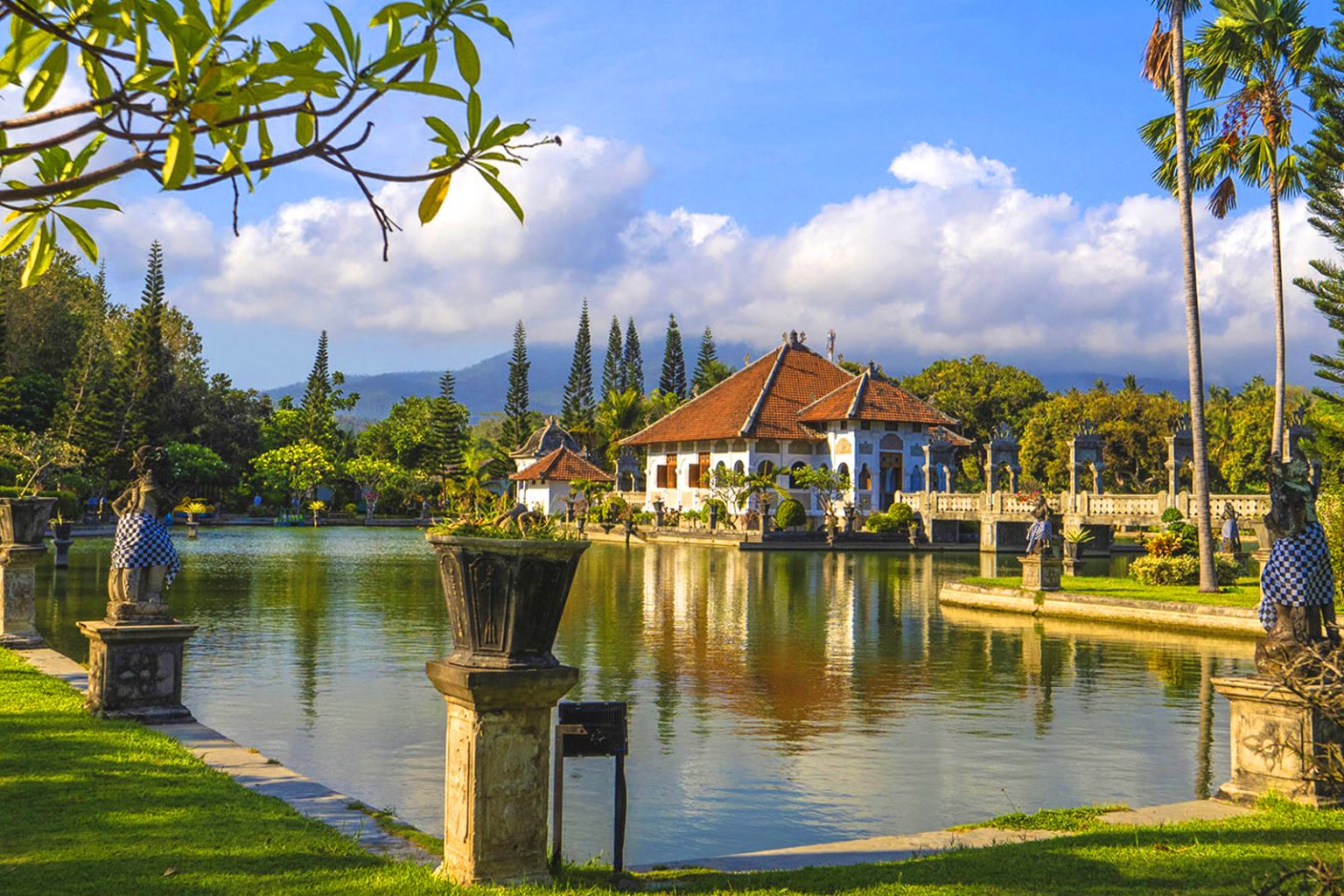
Taman Ujung, about 5 km south-east of Amlapura, was the pleasure garden of Karangasem's last king, I Gusti Bagus Jelantik. Construction began in 1909 around an older pool built in 1901 to cleanse people accused of black magic, and the palace was completed in 1921, designed by the king with Balinese builders, a Dutch architect and a Chinese architect. The 1963 eruption of Mount Agung and earthquakes in the 1970s left it almost entirely in ruins, and it was restored between 1998 and 2001. Entry is around IDR 100,000.
PlaceTirta Gangga: water of the Ganges
Tirta Gangga, near Amlapura, is the sister water palace to Taman Ujung, built in 1946 by the same king of Karangasem. Its name means water of the Ganges, and its centrepiece is an eleven-tiered pagoda-like fountain among koi ponds and stone carvings, in a compact garden of about one hectare. Like Taman Ujung it was almost entirely destroyed by the 1963 eruption of Mount Agung and later rebuilt. Visitors can walk the stepping stones across the koi pond and swim in the spring-fed pool, included in the ticket of around IDR 90,000.
PlaceTaman Ayun: the royal temple of Mengwi
Pura Taman Ayun, at Mengwi, was built in 1634 by the same king of Mengwi who rebuilt Ulun Danu Beratan, I Gusti Agung Putu. It was the royal family temple of the Mengwi kingdom, set in a moated garden with tiered meru towers, and it is one of the five sites in Bali's UNESCO-listed Cultural Landscape of the Subak System. Mengwi was carved up by its neighbours in 1891, but its temple survives as one of the island's grandest.
PlaceTrunyan: the village that does not cremate
Trunyan, on the eastern shore of Lake Batur, is one of Bali's oldest settlements, a Bali Aga village whose customs predate Hindu-Javanese influence. Instead of cremation, certain members of the community are laid to rest above ground under the sacred Taru Menyan tree, inside simple bamboo enclosures, and local belief holds that the fragrant tree keeps the air clean. The village is reached mainly by boat across the lake. This is a real resting place, so follow your guide, stay quiet and do not photograph close up.
FactGilimanuk: Bali's prehistoric dead
The Gilimanuk site, in far west Bali near the ferry port, was found in 1962 when road workers uncovered human remains. Excavations from 1963 to 2013 recovered nearly 140 sets of human skeletons with grave goods, radiocarbon dated to Bali's prehistoric period. Finds from the site are displayed at the Museum of Prehistoric Man in Gilimanuk and at the Museum Sarkofagus in Bedulu. It is the clearest evidence that people lived in Bali long before the first Hindu kingdoms.
PlaceMuseum Sarkofagus: stone coffins of old Bali
The Museum Sarkofagus at Bedulu, near Ubud, holds one of Bali's most important archaeological collections, about 3,000 items from prehistoric times to the 15th century. It was founded on 14 September 1974 as the Gedong Arca Archaeological Museum and renamed Museum Sarkofagus in February 2025 for its collection of stone sarcophagi. Many are shaped like turtles and carved with wide-eyed faces and protruding tongues, believed to protect the coffin and the community from harm.
FactPuputan: the last stand at Badung, 1906
On 20 September 1906, after Dutch troops landed at Sanur, the raja of Badung, his family and his court, dressed in white cremation clothes and carrying their kris, walked out of the palace towards the Dutch guns rather than surrender. This was a puputan, a fight to the end, and hundreds died. The palace of Denpasar was razed to the ground, and the ruler of Tabanan died in captivity soon after. Taman Puputan, the square in central Denpasar, and its monument mark the event, beside the Bali Museum.
FactPuputan Klungkung, 1908: the end of the kingdoms
On 28 April 1908 the Dewa Agung of Klungkung and about 200 followers made the same choice, walking out of their palace in white into Dutch fire after a week of fighting. The royal family was exiled and most of the palace was razed, leaving only the gate, Kerta Gosa and Bale Kambang standing. With Klungkung's fall the whole island came under Dutch rule. The puputan monument opposite the palace in Klungkung marks the spot.
FactMargarana 1946: Bali's last puputan
On 20 November 1946, during the Indonesian war of independence, Lieutenant Colonel I Gusti Ngurah Rai and 95 of his men refused to surrender to a Dutch force of about 2,000 near the village of Marga in Tabanan. They chose a puputan, a fight to the last man, and the entire battalion was killed. Ngurah Rai was later named a National Hero of Indonesia, and Bali's international airport, its largest university and its largest stadium all carry his name. A memorial stands on the battlefield at Marga.
PlaceBali Museum: the palace that became a museum
The Bali Museum in Denpasar was built in 1931 by the Dutch architect P.J. Moojen, on the site of the former royal palace of Denpasar, which had been burnt to the ground in the 1906 puputan, and its walls and courtyards were modelled on the palace. Its four buildings hold prehistoric objects, stone sarcophagi, bronze statues, theatrical masks, textiles and ceremonial equipment, including keris daggers and endek cloth. It stands on the east side of Taman Puputan, Denpasar's central square.
PlaceBajra Sandhi: the bell of the people's struggle
The Bajra Sandhi Monument at Renon in Denpasar commemorates the struggle of the Balinese people through history, from the first kingdoms and the arrival of Hinduism, through the Majapahit era and Dutch colonialism, to independence. It is shaped like a bajra, a Hindu priest's bell, and was built between 1987 and 2001, inaugurated on 14 June 2003. Inside, a museum of dioramas tells the story in pictures, and the viewing platform gives a wide view over Denpasar.
TipTwo classic history day trips
For the ancient heartland, start at Goa Gajah and Yeh Pulu near Bedulu, then drive north to Tirta Empul and Gunung Kawi at Tampaksiring, all within about 30 minutes of Ubud. For the royal east, pair Kerta Gosa in Klungkung with Taman Ujung and Tirta Gangga near Amlapura, and add Lempuyang if you are up early. At working temples, wear a sarong and sash, cover shoulders and knees, and never enter the inner courtyard during a ceremony unless invited.
TipWords to know
pura — temple;
candi — shrine; ancient temple monument;
istana — palace;
puri — a royal palace compound;
kerajaan — kingdom;
peninggalan — relic; something left behind from the past;
arca — statue; carved figure;
prasasti — inscription; engraved stone or copper record;
puputan — a fight to the end; ritual last stand;
meru — tiered temple tower;
candi bentar — split gate marking a temple entrance;
padmasana — open throne shrine for the supreme god;
lontar — palm-leaf manuscript;
sarkofagus — stone coffin;
babad — chronicle; historical account;
Dewa Agung — the senior king of Klungkung;
raja — king; ruler;
kahyangan — heavenly temple; sacred mountain sanctuary;
tirta — holy water;
piodalan — a temple's anniversary ceremony;
odalan — temple festival; anniversary celebration
See also: related sets
Related cards in other sets — tap one to jump to it.