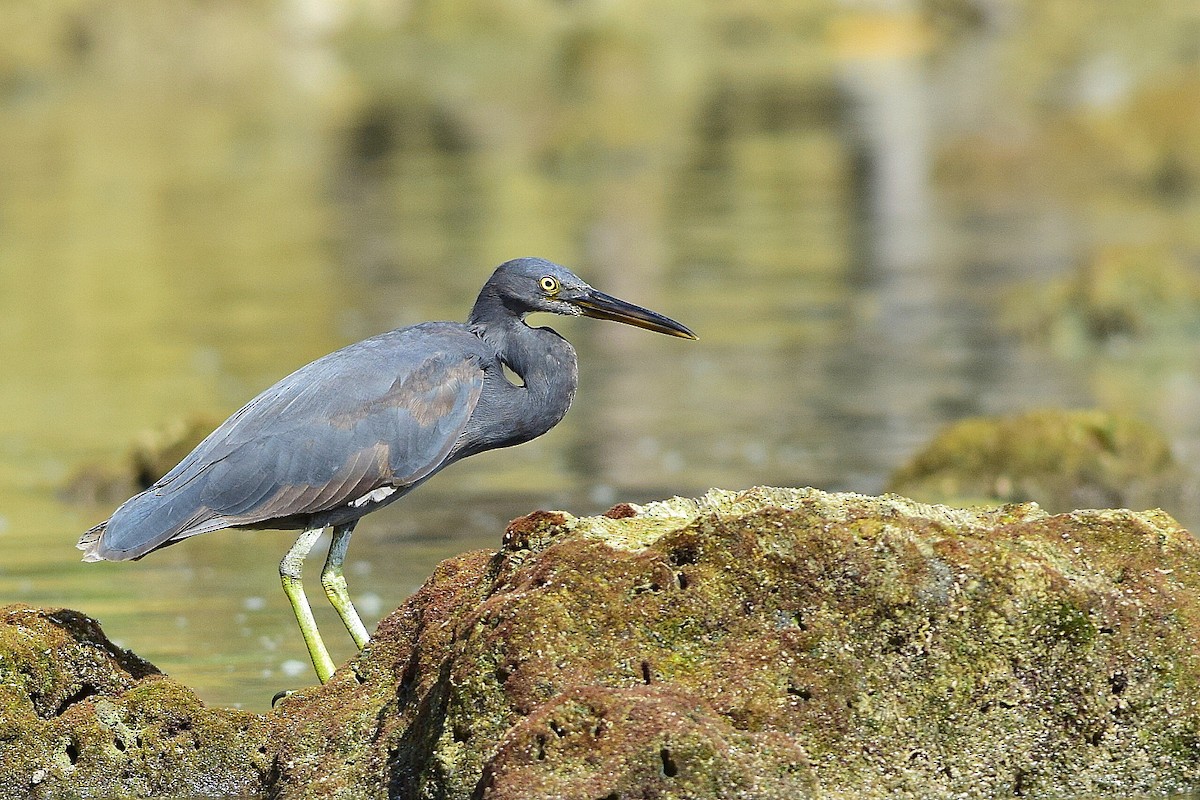
FactWhat is a heron?
Herons are long-legged, long-necked wading birds that hunt in shallow water, and Bali is full of them — from the white egrets in the rice fields to the tall purple heron stalking the lagoons. They belong to the heron family, Ardeidae, which also includes egrets, bitterns and night herons. You will see them standing motionless in a flooded paddy, wading the edge of a mangrove channel, or flying overhead with slow, deep wingbeats.
FactBali's heron family — more than a dozen kinds
Bali's mainland bird checklist records more than a dozen herons and egrets: Javan pond heron, cattle egret, little egret, intermediate egret, great egret, purple heron, grey heron, striated heron, Pacific reef heron, black-crowned night heron, Nankeen night heron and Malayan night heron, plus the yellow bittern and the rare Chinese egret. Most are resident all year, and a few are rare visitors that birdwatchers get excited about. The island's total bird list runs to over 420 species.
FactJavan pond heron — the one you will see most
The Javan pond heron is Bali's commonest heron, and the one you will see in almost every rice field. Out of breeding season it looks plain: streaky brown and white, hunched over the water's edge. It is easy to walk past — until it unfolds its wings and shows the bright white flight feathers. It is found all over Bali, from Ubud's paddies to the coastal lagoons.
FactJavan pond heron in breeding dress
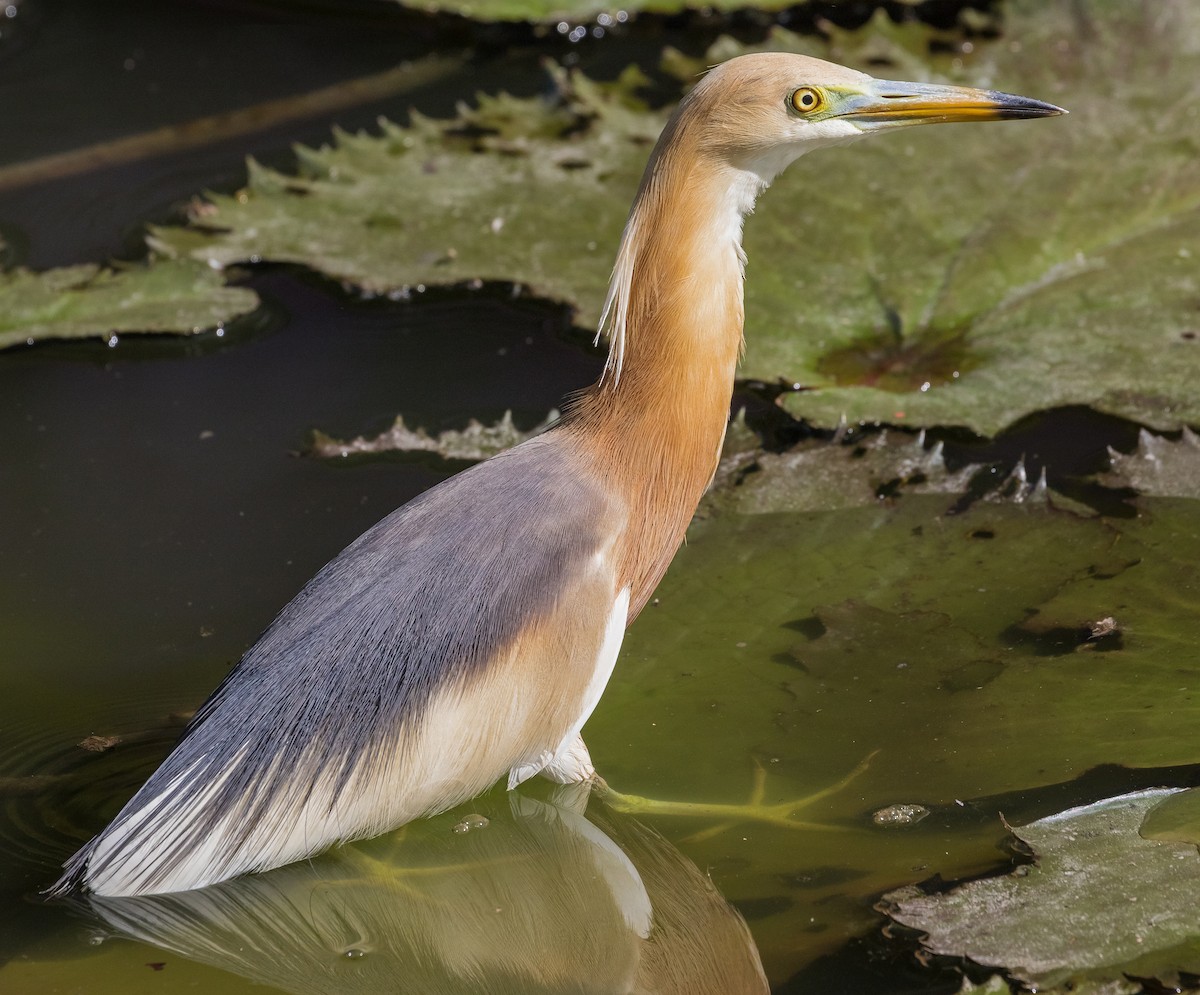
In the breeding season the Javan pond heron transforms: the head and neck turn a rich buff-orange, the back goes slate grey, and two long white plumes trail from the back of the head. The change is so dramatic that first-time visitors often think they are looking at a different bird. Breeding in Bali peaks around the wet season, when the rice fields are flooded and full of food.
FactCattle egret — the white egret of the fields
The cattle egret is the small white egret you see in flocks in the rice fields and dry grassland, and it is the bird of Petulu village. In breeding plumage it grows a buff-orange wash on its crown, neck and back, and its bill turns orange-yellow. It is the most numerous heron at Petulu, and the one most visitors photograph — thousands of them roost in the village trees each evening.
FactEgrets and the buffalo
Cattle egrets follow grazing animals for a reason: as a buffalo or cow walks through the grass, it flushes grasshoppers, crickets and other insects, and the egret snaps them up. The birds ride on the animals' backs, walk beside their feet and perch on fences waiting for the herd to move. In the rice fields the same trick works with farmers and their ploughs — the egrets follow the plough and pick off the frogs, worms and insects churned up in the mud.
FactLittle egret — black bill, yellow feet
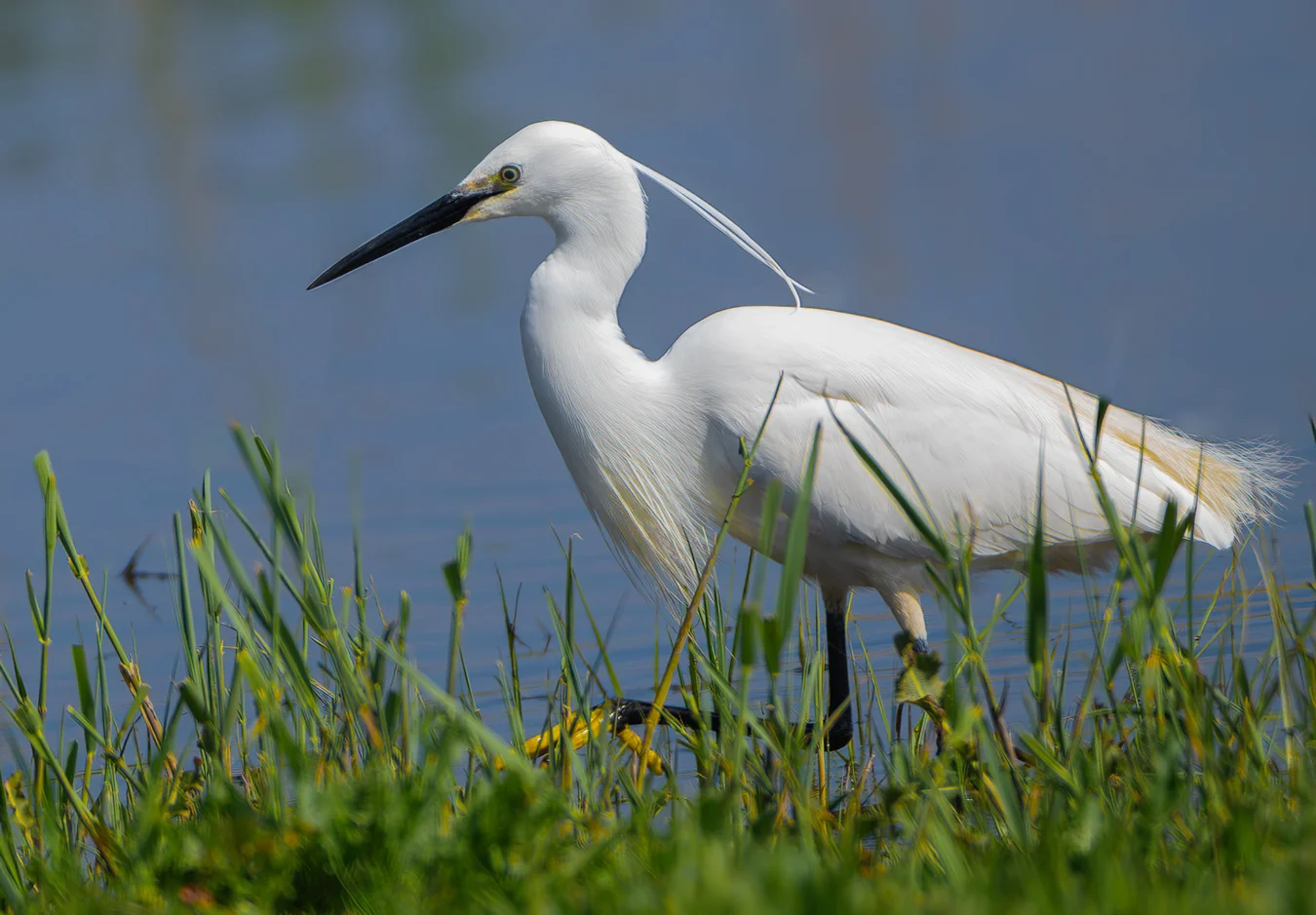
The little egret is the elegant small white egret with a slender black bill, black legs and bright yellow feet — the yellow feet are the giveaway, and they show clearly when it wades. In breeding season it grows two long head plumes and wispy feathers on its chest. It hunts in shallow water, sometimes shuffling its yellow feet to stir up small fish and shrimps. It is common in Bali's rice fields, lagoons and mangrove edges.
FactIntermediate egret — the middle one
The intermediate egret, also called the medium egret, sits between the little and great egrets in size — about 65–70 cm tall, all white, with a yellow bill and dark legs. Telling the three white egrets apart is a classic Bali birding puzzle: little egret has a black bill and yellow feet, intermediate has a yellow bill and a shorter neck, and great egret is much taller with a long, kinked neck. Intermediate egrets are regular in Bali's wetlands and rice fields.
FactGreat egret — the tallest, and a rare one here
The great egret is the tallest of Bali's white egrets, standing about a metre high with a long, S-curved neck and a yellow dagger bill. It is a striking bird, but it is a rare visitor to Bali rather than a resident — the island's checklist marks it rare or accidental, so a sighting is a lucky day. When it does appear, look for it in the big wetlands: the Nusa Dua lagoons, the Bali Barat coast and the larger estuaries.
FactPurple heron — the tall, snake-necked hunter
The purple heron is Bali's most dramatic heron: up to a metre tall, with a long snake-like neck, chestnut and slate-grey plumage and a yellow-orange dagger bill. It hunts in deep reedbeds and lagoons, standing motionless for minutes before striking. Birding reports from the Nusa Dua settling ponds describe it lowering its head and neck, then stabbing into the water to impale fish. It is common enough in Bali's wetlands to be a realistic target for a morning's birding.
FactGrey heron — the rare one
The grey heron is the big grey heron of Europe and Asia, but in Bali it is a rare visitor — the island checklist marks it rare or accidental, and most years only a bird or two is recorded. It looks much like a larger, greyer version of the purple heron, with a white head, black eyebrow stripe and yellow bill. If you think you have seen one in a Bali wetland, check carefully: the purple heron is the common tall heron here, and the grey heron is the one birdwatchers travel for.
FactStriated heron — the small mangrove heron
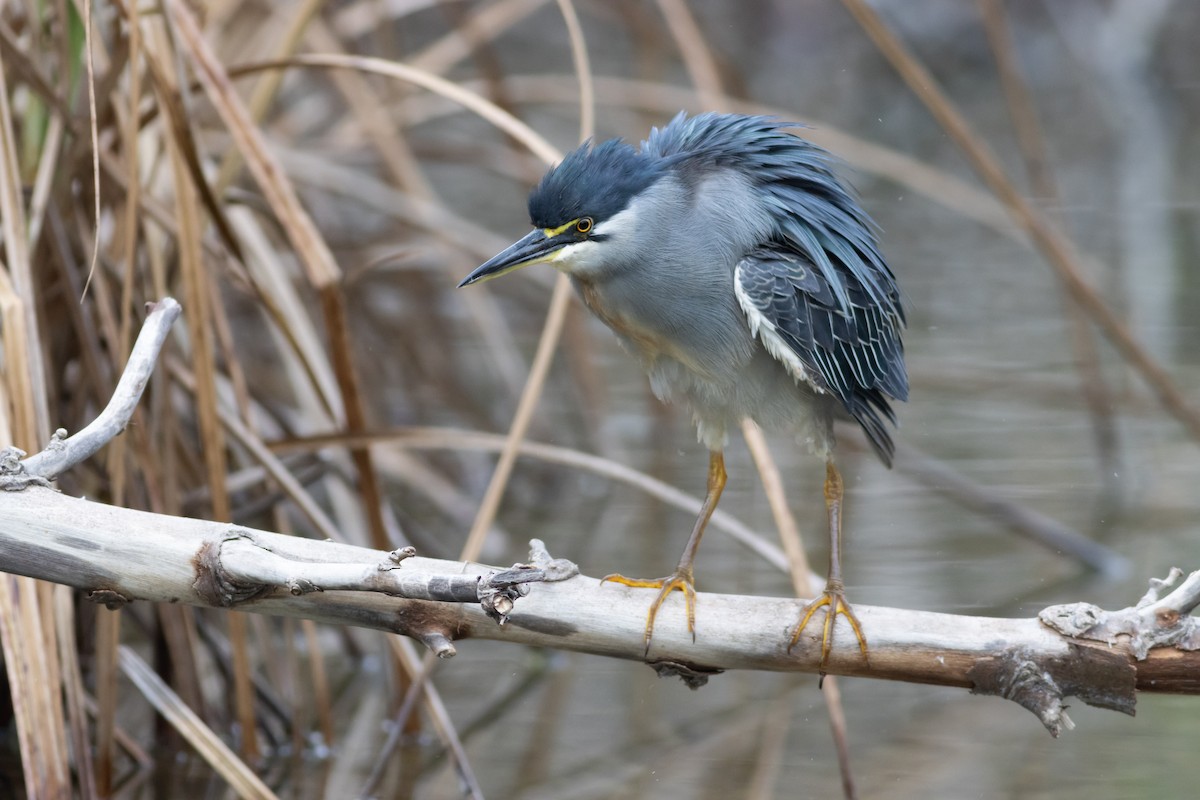
The striated heron, also called the little heron, is the small, hunched heron of Bali's mangroves, rocky shores and pond edges — only about 40–45 cm tall. It is slate grey with a dark cap, a yellow stripe through the eye and yellow legs, and it stands motionless for long stretches before darting at a fish or crab. It is one of the easiest herons to approach, and it is common around Sanur's mangroves, the Benoa Bay channels and the Nusa Dua shore.
FactBlack-crowned night heron — the evening shift
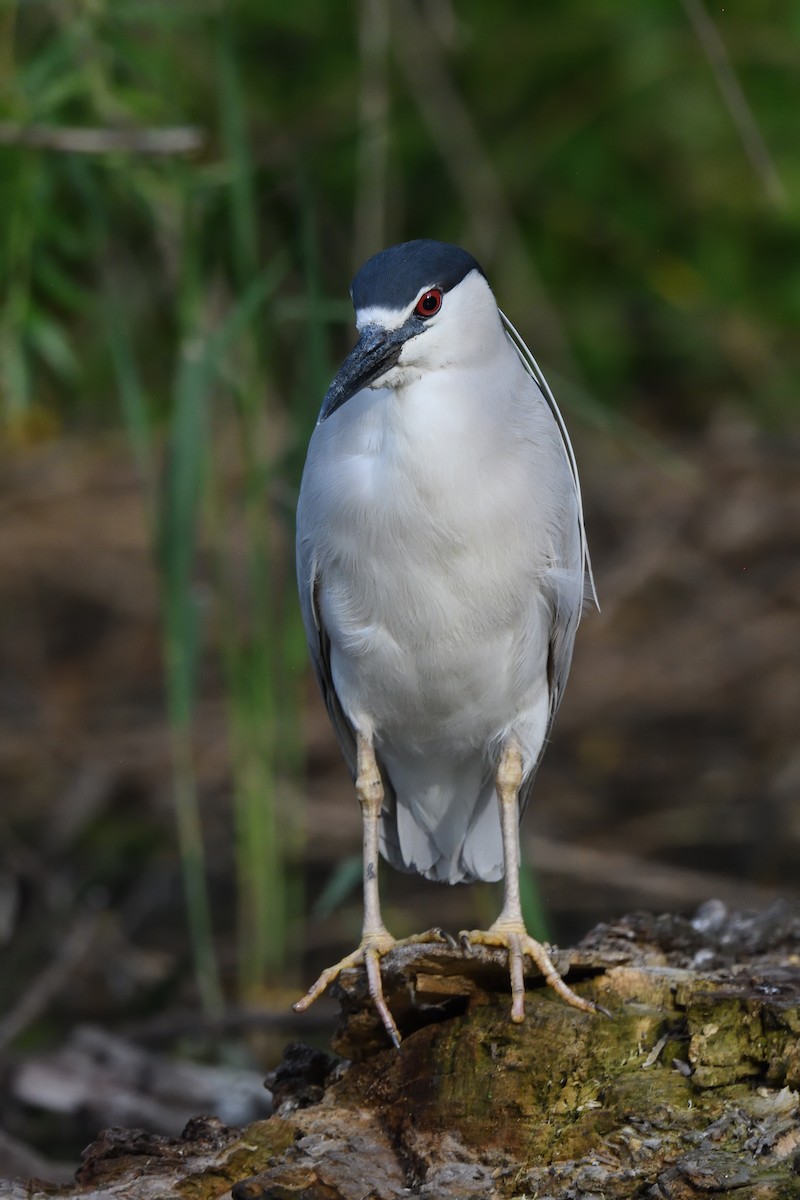
The black-crowned night heron works the night shift: by day it roosts hunched in trees, and at dusk it flies out to fish the paddies, ponds and mangrove channels. It is stocky and short-necked for a heron, with a black cap and back, grey wings, white underparts and a striking red eye. In Bali it is common, and it is one of the birds you will see at the Sanur mangrove boardwalk and around the Nusa Dua lagoons. Listen for its harsh 'quok' call as it flies over at dusk.
FactPacific reef heron — the shore heron, in two colours
The Pacific reef heron lives where the sea meets the land: rocky shores, reef flats and harbour walls. It comes in two colour forms — slate grey and pure white — and both can occur in Bali, which confuses first-time watchers. The white form looks like a small egret, but the reef heron is stockier, with a thicker yellowish bill and yellow-green legs, and it hunts crabs and small fish in the rock pools. Look for it at low tide on the Sanur and Nusa Dua shores and around Bali Barat's coast.
FactThe Chinese pond heron that isn't here
Guidebooks sometimes list the Chinese pond heron for Bali, but it is not on the island's mainland bird checklist — the pond heron of Bali is the Javan pond heron, its close cousin. The two look very similar out of breeding season, and the Chinese pond heron does occur elsewhere in the Greater Sundas, so a stray bird is not impossible — but a pond heron in a Bali rice field is a Javan pond heron unless proven otherwise. It is a good reminder that Bali's birds have their own local cast.
FactHow a heron hunts — stand, wait, spear
A heron hunts by patience: it stands motionless at the water's edge, neck folded into an S, watching for a fish, frog or crab. When prey comes in range, the neck uncoils in a blur and the dagger bill spears or grabs it. Some species shuffle their feet to stir up prey, and the little egret has been seen snatching fish from the surface in flight. A heron can stand in one spot for twenty minutes without moving — which is why they look like statues until they strike.
FactThe S-shaped neck in flight
The surest way to tell a heron from a stork in the air is the neck: herons fly with their necks folded back into a tight S-shape, while storks fly with their necks stretched straight out. It is the single most reliable field mark, and it works at a great distance. Herons also fly with slow, deep wingbeats and their long legs trailing behind them. Watch the evening flight into Petulu and you will see hundreds of folded necks against the sunset.
FactHerons of the rice fields and subaks
Bali's flooded rice fields are heron country: the subak irrigation system keeps water in the paddies for much of the year, and the fields are full of frogs, small fish, crabs and insects. Javan pond herons stalk the field edges, cattle egrets follow the farmers and their buffalo, and little egrets work the shallow water. The best rice-field heron watching is around Ubud, Jatiluwih and the Pupuan terraces — and you do not need to go far: many hotels have paddies right outside the garden.
PlacePetulu — the heron village
Petulu is a quiet village about 2.5 km north of Ubud, a 15-minute drive towards the Tegallalang rice terraces — and every evening it fills with herons. Thousands of white herons, mostly cattle egrets and Javan pond herons, roost in the village's bunut fig trees, nesting in the canopy right above the houses and the road. The birds are sacred to the village and protected by village custom; small warungs have set up in the paddy fields so visitors can watch over a drink.
FactThe evening return — be there after 5pm
The Petulu spectacle happens at dusk: from about 5pm the herons stream back from the rice fields in loose flocks, squabbling over the best perches before settling into the trees. Lonely Planet describes up to 20,000 birds arriving on a good evening. Arrive by 4:30pm, find a warung seat in the paddies, and stay until the sky darkens — but walk quickly under the roost trees, and expect the smell and the mess that come with thousands of birds overhead.
FactThe 1965 story — a ceremony, then the birds arrived
The herons first came to Petulu on 7 November 1965, a fortnight after the village held a large cleansing ceremony at its temple on 25 October 1965. The village's own account says a small flock of white birds landed in a tree during the preparations, one was used in the ceremony as a ritual offering, and afterwards the birds returned in ever greater numbers. The villagers took it as a blessing from the temple god, welcomed the birds with a special ceremony, and built a shrine to them at the village temple — and the herons have returned every evening since.
FactThe other legend — the souls of 1965
There is a second, darker story told about Petulu, and visitors will hear both. In 1965–66, during the anti-communist killings that followed the failed coup, many people were killed in Bali, and fields near Petulu were reportedly among the killing sites. The legend says the herons are the reincarnated souls of those who died, arriving just after the killings — which is why the birds are treated as sacred and never harmed. The village's official story is the blessing after the ceremony; the other tale is whispered, and both are part of Petulu.
FigurePetulu by the numbers
A 2017 study counted more than 4,000 herons and 1,241 nests in Petulu village. A later Udayana University study of the cattle egret there found the population swings sharply with the seasons: about 625 birds in August 2019, more than 7,000 in February 2020, and about 465 in July 2020. The birds breed from around December to February, nest in the village's fig trees — mostly Ficus subcordata, the bunut — and the fledglings take flight in March.
PlaceSanur mangrove boardwalk — herons in the city
The Mangrove Information Centre, off the Ngurah Rai bypass about 8 km south of Sanur, is the easiest place to walk among herons near the south Bali resorts. Its wooden boardwalk runs about 2 km through 100 hectares of mangrove forest inside the 1,373-hectare Tahura Ngurah Rai protected area, with observation towers for a view over the canopy. Black-crowned night herons, egrets and kingfishers work the channels below. Entry was about IDR 200,000 for foreigners in older guides (approximate) — and a 2026 guide reports the boardwalk has been closed to walk-in visitors at times, so check its status before you go.
PlaceBenoa Bay by kayak — herons at water level
The mangroves of Benoa Bay, between the airport and Nusa Dua, are best seen from the water: kayak tours paddle the tidal channels at mid-tide, when the water is deep enough to move but low enough to show the roots. Egrets and herons stalk the mud at the channel edges, kingfishers dart between the roots, and mudskippers hop across the flats. Go in the morning, when the birds are active and the wind is low, and time your trip to the tide — at dead low water even a kayak grounds on the mud.
PlaceNusa Dua lagoons — hundreds of egrets, if you can get in
The lagoons and settling ponds around Nusa Dua are one of Bali's richest heron sites: birding reports describe hundreds of egrets, herons and cormorants, with purple herons, great egrets, little egrets and striated herons all seen in one morning. The catch is access — the ponds are part of a water-treatment facility that is not open to the public, and birders have had to arrange entry in advance. Do not turn up expecting to walk in; the public alternative is the lagoon shore and the mangrove edges around Nusa Dua.
PlaceBali Barat wetlands — the wild north-west
West Bali National Park, in the island's far north-west, is Bali's wildest birding ground: more than 160 bird species in monsoon forest, savanna, mangroves and coral coast. Herons and egrets work the tidal channels and salt pans, and the park's checklist includes the rare great-billed heron and the Nankeen night heron alongside the common species. It is a long drive from the south — about three hours from Ubud — so most visitors go with a guide and make a day of it, combining the wetlands with the Bali starling release sites.
FactHerons in Balinese culture — sacred, lucky, protected
The white heron, kokoan, is considered sacred and lucky in Bali, and in Petulu the birds are protected by village customary law, awig-awig — a 2022 Udayana University study documents the community's conservation of the cattle egret under that law. Villagers believe the herons bring good luck and prosperity, and harming one is unthinkable. Herons also appear in Balinese art and temple carving as symbols of patience and grace, and their evening flight is one of the island's quiet daily rituals.
TipBest times, and how to watch and photograph them
Herons are most active at dawn and dusk: the first hour after sunrise and the last hour before sunset, when they feed and when the Petulu birds fly home. In the middle of the day they roost in trees or stand dozing in the shallows. For photography, keep your distance and use a long lens — herons flush easily — and never use a flash near a roost. Stay on paths and boardwalks, do not walk into the paddies, and never disturb a nest: a heron that leaves its nest may not come back.
FactHeron, stork or ibis? How to tell them apart
Three families of long-legged waders cause confusion in Bali, and the clues are the bill and the neck in flight. Herons have dagger bills and fly with the neck folded into an S; storks have much heavier, stouter bills and fly with the neck stretched straight out — the woolly-necked stork and the near-threatened lesser adjutant are Bali's storks, both rare visitors. Ibises have bills that curve downwards, like a sickle — the glossy ibis is on Bali's checklist but is rare. If the bill curves down, it is an ibis; if the neck is outstretched in flight, it is a stork.
TipWords to know
bangau — heron;
kokoan — white heron; egret;
kuntul — egret;
sawah — rice field;
subak — irrigation cooperative; rice-field water system;
bunut — weeping fig tree; the herons' roost tree at Petulu;
sarang — nest;
telur — egg;
anak burung — chick; baby bird;
paruh — bill; beak;
sayap — wing;
bulu — feather;
terbang — to fly;
ikan — fish;
katak — frog;
kerbau — water buffalo;
sapi — cow; cattle;
bakau — mangrove;
muara — estuary; river mouth;
senja — dusk; twilight;
fajar — dawn;
suci — sacred; holy;
awig-awig — village customary law
See also: related sets