FactNo trains, no metro — Bali runs on roads
Bali has no trains, no metro and no subway of any kind, so every trip is by road. That means cars, scooters, buses and boats do all the work, and traffic is the single biggest factor in how long anything takes. Plan your days around the roads, not around a timetable.
FactBali drives on the left
Traffic keeps to the left, the same as in Australia, the UK and Japan. If you are used to driving on the right, the first day on a scooter or in a hire car needs extra concentration, especially at roundabouts and when turning across traffic. Pedestrians should look right first when crossing.
FactNarrow roads and rush hours set the pace
Most roads outside the main highways are narrow, two-lane and shared with scooters, trucks, dogs and ceremony processions. Peak hours run roughly 7:30–9:30am and 4–7pm, when a 20 km trip can easily take over an hour. Allow far more time than the distance suggests.
FactScooter hire: you need a motorcycle licence
Since 2019, riding a scooter legally in Bali requires an International Driving Permit with a motorcycle endorsement, plus your home motorcycle licence. A car-only licence does not cover you. Police do roadside checks in tourist areas and on-the-spot fines run from about IDR 250,000 to IDR 1,000,000.
FigureScooter hire costs about IDR 60,000–80,000 a day
A standard 110–125cc automatic scooter rents for roughly IDR 60,000–80,000 per day, with weekly and monthly rates cheaper per day. Larger models such as the Yamaha NMAX or Honda PCX cost around IDR 150,000 a day. The price usually includes a helmet, though the helmet is often basic — bring or buy a better one if you plan to ride far.
FactHelmets are compulsory — for rider and passenger
Indonesian law requires a helmet for everyone on a motorbike, rider and passenger alike. Police fine bare-headed riders, and head injuries are the leading cause of serious harm in scooter crashes. Wear the strap done up, not hanging loose, and never ride with a helmet balanced on your arm.
TipNo valid licence usually means no insurance
Riding without the correct licence usually voids your travel insurance, so a crash can leave you paying hospital bills yourself — and Bali hospital bills for a serious accident can be very large. Check your policy's exact wording on motorcycles before you hire, not after a crash.
Figure142 accidents involving foreigners in 2024
Bali police counted 142 road accidents involving foreigners in 2024, with 21 deaths — up about 35% on 2023. The common causes are inexperience on two wheels, unfamiliar roads, alcohol, and riding at night or in the rain. If you have never ridden a scooter at home, Bali's busy roads are not the place to learn.
TipWhere to rent a scooter safely
Rent from your hotel, a well-reviewed local shop, or a rental your accommodation recommends — avoid touts on the street. Before you pay, photograph the bike from all sides, note existing scratches on the rental form, and check the brakes, lights, horn and tyres yourself. Keep the rental agreement and the bike's registration papers with you.
TipRain, night and phones: the three scooter risks
Tropical rain makes roads slippery within minutes, especially the painted lines and the first rain after a dry spell — pull over and wait it out. Avoid riding after dark when you can: lighting is poor and hazards are hard to see. Never use your phone while riding; pull over to check directions.
FigureA private driver costs about IDR 500,000–700,000 a day
Hiring a car with a driver for a full 8–10 hour day costs roughly IDR 500,000–700,000, with fuel and parking usually included. A half day of around 4–5 hours runs about IDR 300,000–450,000. For two or more people this is often cheaper and far less stressful than scooters plus taxis.
TipHow to find a good driver
The best drivers come by recommendation — ask your hotel, your villa host, or a fellow traveller, and check recent reviews. A good driver speaks reasonable English, knows the back roads, waits patiently while you explore, and suggests stops without pressuring you into commission shops. Agree the price, the route and the hours before you set off.
FactFull day vs half day: pick by distance
A half day suits one area — Ubud and its surrounds, or a south Bali beach run. A full day is the right choice for long hauls such as Uluwatu to Ubud, a north Bali loop, or a sunrise trek plus sightseeing. If the driver waits hours at a temple or a beach club, that waiting time is part of the day you booked.
TipTipping your driver is appreciated, not expected
Tipping is not compulsory in Bali, but drivers genuinely appreciate a cash tip at the end of a good day, especially after a long or flexible one. A small tip on top of the agreed price is the usual gesture. If the driver went well beyond the plan — an extra stop, a late finish — a little more is fair.
FactGrab and Gojek: Bali's ride-hailing apps
Grab and Gojek are the two ride-hailing apps that work across Bali, for both cars (GrabCar/GoCar) and motorbike taxis (GrabBike/GoRide). Download and set them up before you arrive, with your payment method added. You see the price before you book, and the driver and vehicle details are on screen.
FactGrabBike is fast and cheap; GrabCar is comfortable
A motorbike taxi is the quickest way through traffic and the cheapest option for one person with a small bag — short rides run roughly IDR 8,000–25,000. A car costs more but suits groups, luggage, rain and night trips. Both apps also deliver food, which is handy on a quiet night in.
FactRide-hailing has no-go pickup zones
Local taxi groups restrict app pickups in some areas — central Ubud around the palace and Monkey Forest, Uluwatu and Bingin, Tanah Lot, Padang Bai and parts of Canggu. Drop-offs are usually fine; it is the pickup that is blocked. If the app cannot find a driver, walk a few minutes out of the restricted zone and try again.
FigureApp prices: airport to Ubud about IDR 200,000–320,000
As a guide, a Grab or Gojek car from the airport to Ubud costs roughly IDR 200,000–320,000, and short hops around Seminyak or Canggu are about IDR 8,000–25,000 on a bike. Prices rise in rain and at peak times. The app quote is the price — confirm it matches before you get in.
FactBlue Bird: the metered taxi to trust
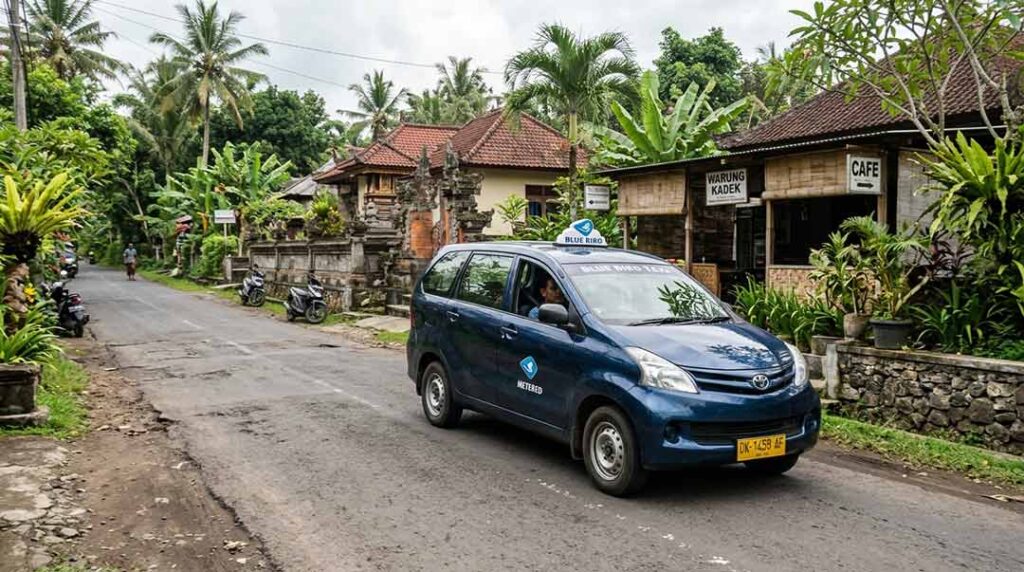
Blue Bird Group runs Bali's reliable metered taxis — light-blue cars with a roof sign and 'Blue Bird' branding. The meter starts at about IDR 7,000, then roughly IDR 6,500 per kilometre. You can flag one down, call, or book through the Blue Bird app. Always insist the meter is on.
TipHow to spot a fake taxi
Unmetered cars often copy Blue Bird's light-blue colour but lack the proper roof sign, door logo and meter — some even use the name 'Blue Bird' with a different bird logo. If there is no working meter, the driver names a flat price, or the branding looks slightly off, walk away and book through the app instead.
FactAt the airport, use the official taxi counter
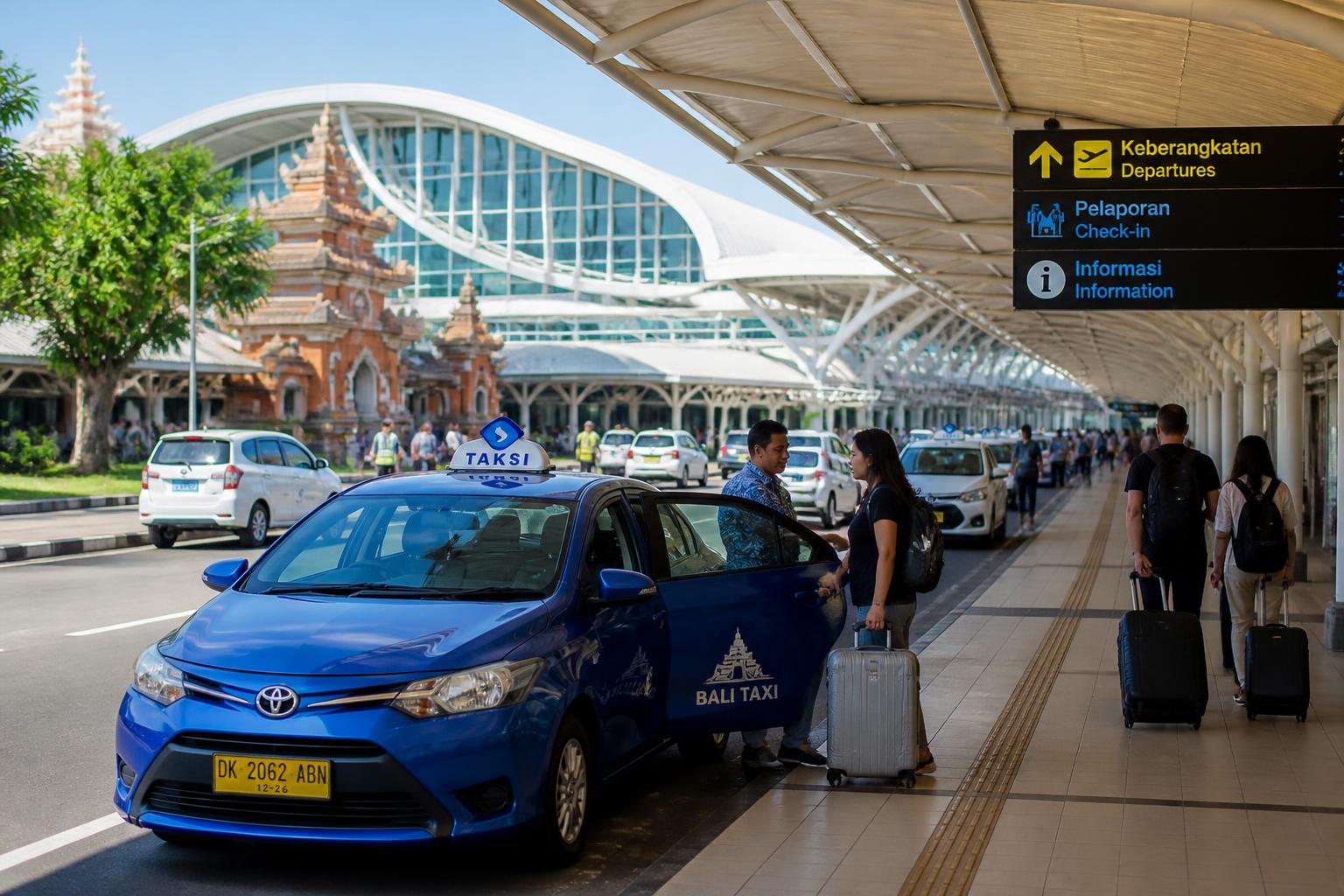
Inside Ngurah Rai arrivals there is an official airport taxi counter where you pay a fixed price by destination and get a receipt. It costs more than an app car, but it is the safest option late at night or if your phone has no data. Avoid the touts who approach you in the arrivals hall.
FigureAirport to Ubud: 1.5 to 2.5 hours
The drive from Ngurah Rai Airport to Ubud takes about 1.5 to 2.5 hours depending on traffic, and longer in the late-afternoon rush. A Blue Bird metered taxi runs roughly IDR 300,000–450,000, while a Grab or Gojek car is usually about IDR 200,000–320,000. Pre-booking a hotel transfer is the most relaxed option after a long flight.
FactAirport to Kuta, Seminyak and Canggu
Kuta, Legian and Seminyak sit closest to the airport, so transfers there are the shortest and cheapest of the main resort runs. Canggu is further and its narrow streets jam badly at sunset. Wherever you are headed, agree the price or book in the app before you leave the terminal.
FactTrans Metro Dewata: the IDR 4,400 city bus
Trans Metro Dewata is Bali's public bus network, running six corridors around Denpasar, Kuta, Sanur, Ubud and Nusa Dua for a flat fare of about IDR 4,400. It is cashless — pay by QRIS or e-money card — and the service resumed in April 2025 after a suspension. It is slow but it is real public transport, and it is air-conditioned.
FactKura-Kura Bus: the tourist shuttle
The Kura-Kura Bus runs scheduled shuttles between the main tourist areas — Kuta, Seminyak, Sanur, Ubud and Nusa Dua — with fixed stops and a timetable. A one-way ride such as Kuta to Ubud costs around IDR 100,000. It is a comfortable middle ground between the city bus and a private car.
FactBemo and the Perama shuttle
Bemo are the small shared minibuses that run set routes around Denpasar and between towns — flag one down, pay a small fare agreed on the spot, and expect a slow, local ride. Perama runs tourist shuttles between Ubud, Kuta, Sanur, Lovina, Padang Bai, Candidasa and Amed; book a seat ahead, as departures are limited.
FactFast boats to Nusa Penida and Lembongan
Fast boats leave Sanur for Nusa Penida and Nusa Lembongan throughout the morning, taking about 30–45 minutes and costing roughly IDR 170,000–215,000 one way when booked online. Expect a wet landing at some island beaches, where you step from the boat into shallow water. Book the day before in peak season.
FactFerries to Java and Lombok
The Gilimanuk–Ketapang ferry to Java runs 24 hours, takes about 45–60 minutes, and costs around IDR 10,600 for an adult — tickets are sold online only through Ferizy. The Padang Bai–Lembar ferry to Lombok takes about 4.5 hours and costs around IDR 65,300. Fast boats from Padang Bai reach the Gili Islands in about 1.5 hours, from around IDR 285,000–425,000.
PlaceSanur's beachfront path: Bali's best walk and ride
Sanur has a paved, mostly car-free beachfront promenade of about 5–7 km, lined with cafes, warungs and shade trees — the easiest place in Bali to walk or cycle safely. Hire a bicycle from a shop along the path and ride the whole stretch at sunrise. Elsewhere, footpaths are often broken, blocked or missing, so walking on main roads needs care.
TipDriving yourself: a hire car is rarely the best choice
Self-drive car rental is possible, but it is rarely the best option for a tourist: left-hand traffic, narrow roads, scarce parking in Ubud and Canggu, and local driving habits that take getting used to. A car with a driver costs little more and removes all of that. If you do self-drive, you need an International Driving Permit and a car licence.
TipWords to know
ojek — motorbike taxi;
sopir — driver;
helm — helmet;
jalan — road or street; also 'to walk';
macet — traffic jam;
kiri — left;
kanan — right;
lurus — straight ahead;
belok — to turn;
berhenti — to stop;
parkir — to park;
bensin — petrol;
pom bensin — petrol station;
tarif — fare or rate;
argo — taxi meter;
antar — to take or deliver someone somewhere;
jemput — to pick up;
pelabuhan — port or harbour;
kapal — boat or ship;
feri — ferry;
penyeberangan — crossing (by boat or ferry)
See also: related sets
Getting around Bali means boats, bikes, buses and the airport — these sets carry on from here.