FigureMore than 350 butterfly species live in Bali
Bali is home to a remarkable variety of butterflies: the first scientific list, published in 1898, recorded 201 species, and modern guides put the total above 350. Most are widespread Southeast Asian species shared with Java and the other Sunda Islands. One visiting naturalist recorded more than 90 species in just four days of watching in 2019, which gives a sense of how rich a single trip can be.
FactButterflies live everywhere tourists go
You do not need to trek into remote jungle to see Bali's butterflies. They are common in hotel gardens, rice fields, forest edges, temple grounds and around waterfalls, wherever there are flowers to feed on and sunny spots to warm up. The island's two butterfly parks simply concentrate them in one place, which is why they are the surest bet for a first-timer.
FactThe common birdwing: Bali's biggest butterfly
The common birdwing (Troides helena) is the star of Bali's butterfly world. Males are velvet black with silky golden-yellow hindwings, while females are larger, with black spots on their golden hindwings. It is the one true birdwing that lives wild in Bali, and it is the species the butterfly parks breed in large numbers.
FigureA birdwing's wingspan can reach 17 centimetres
The common birdwing's wingspan ranges from about 100 to 170 millimetres, roughly the width of an adult's hand. Females are the larger sex, and their wings carry a row of black spots on the gold. When one drifts past you on a forest path, slow and unhurried, it is unmistakable — nothing else in Bali flies quite that big or that slowly.
FactBirdwing caterpillars eat only one plant — and turn poisonous
Common birdwing caterpillars feed only on Dutchman's pipe vine (Aristolochia), a plant whose toxins they store in their bodies. That makes both caterpillar and adult distasteful to birds, which is why the butterfly can afford to fly slowly in the open. Look for the vine's odd pipe-shaped flowers in gardens and at the butterfly parks, where the caterpillars are easy to spot.
FactTwo famous birdwings you will NOT see wild in Bali
Rippon's birdwing (Troides hypolitus) lives only in the Moluccas and Sulawesi, and the Priam's birdwing (Ornithoptera priamus) is a Maluku and Papua species — neither occurs wild in Bali. The butterfly parks do breed and display them, so you may still see one behind netting. If a guide claims otherwise in the wild, they are mistaken.
FactThe great Mormon: Bali's most variable swallowtail
The great Mormon (Papilio memnon) is a large swallowtail common in Bali's gardens and forest edges. Males are black with blue-grey streaks, while females come in several different forms, some mimicking unpalatable species. It is a strong, fast flier that often visits hibiscus and other garden flowers in the morning.
FactThe lime butterfly loves citrus trees
The lime butterfly (Papilio demoleus) is named for its caterpillars' favourite food: citrus leaves. It is one of the commonest butterflies in Bali's gardens and villages, a black-and-yellow swallowtail with a distinctive row of yellow spots. Gardeners know it well, but for visitors it is a cheerful, easy-to-spot introduction to the island's swallowtails.
FactThe common crow: dark wings, white spots
The common crow (Euploea core) is a slow-flying, dark brown butterfly with white spots along its wing edges, common all over Bali. Like the birdwing, its caterpillars feed on toxic plants, so birds leave it alone — which is why it drifts along so lazily. It often feeds on lantana and other small garden flowers in the heat of the day.
FactThe blue moon: a butterfly that changes its spots
The blue moon, or great eggfly (Hypolimnas bolina), is a striking Bali butterfly: males are black with shimmering iridescent blue patches and white spots. Females are famously variable, with several different colour forms, some mimicking the toxic common crow. Look for it along forest edges and in gardens, often basking with its wings open in the sun.
FactThe painted jezebel: yellow wings, red spots
The painted jezebel (Delias hyparete) is one of Bali's prettiest butterflies: white and black above, with bright yellow hindwings marked underneath with black veins and orange-red spots. It flies high in the treetops but comes down to feed on flowers, and it is common around gardens and forest edges. Its wingspan is about 70 to 80 millimetres.
FactThe Bali peacock: a green jewel of the forest
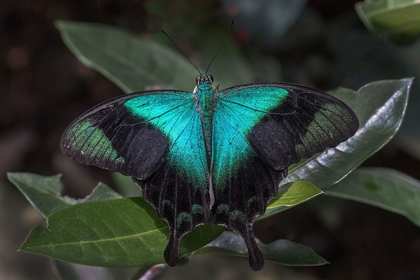
The Bali peacock (Papilio peranthus) is a black swallowtail with metallic green and blue-green bands and club-like tails, found in Bali as the subspecies transiens. Its wingspan is about 70 to 90 millimetres. It favours forest edges and shaded paths, and its green sheen is most vivid in bright sunlight.
FactThe tailed jay: green spots on black
The tailed jay (Graphium agamemnon) is a fast, restless butterfly with dark wings patterned in bright green spots and a short tail on each hindwing. It is common in Bali's gardens and along forest trails, where it darts between flowers and rarely sits still for long. Its green markings make it easy to recognise even in flight.
FactThe Malay lacewing: orange, black and white lace
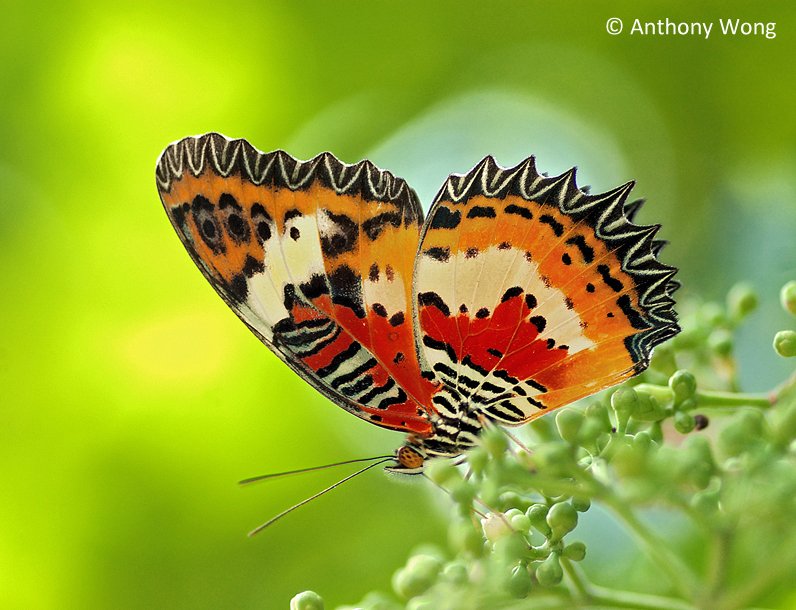
The Malay lacewing (Cethosia hypsea) is one of the most eye-catching butterflies in Bali's butterfly parks: bright orange wings patterned with black and white, edged with a scalloped black border dotted with white crescents. In the wild it favours forest edges, where its caterpillars feed on passionflower vines. It is a favourite subject for photographers because it often sits with its wings open.
PlaceBali Butterfly Park, Tabanan: the original
Bali Butterfly Park (Taman Kupu-Kupu) in Tabanan, on Jl. Batukaru No. 76, was established in 1993 and is Bali's oldest butterfly park. Its netted garden covers about a hectare, with around 15 species bred on site, plus stick insects, Atlas moths and a chrysalis station where you can watch butterflies emerge. It is open daily about 8am to 5pm, last entry around 4pm; foreign adult entry is approximately IDR 100,000 and foreign child entry approximately IDR 50,000.
PlaceKemenuh Butterfly Park: Ubud's butterfly garden
Kemenuh Butterfly Park, in Gianyar about 9 to 10 kilometres south of Ubud, is Bali's second butterfly park, founded by Ida Bagus Witara. It holds around 14 species and more than 500 butterflies, including tree nymphs, lacewings, common crows, tailed jays and birdwings, plus a cocoon house, a pupa room and a small museum of framed insects. It is open about 9am to 6pm; adult entry is approximately IDR 100,000 and child entry approximately IDR 50,000 to 75,000.
PlaceButterflies in the wild: rice fields, waterfalls and forest edges
Outside the parks, the best butterfly watching is along forest edges, rice-field bunds, riverbanks and the paths to waterfalls such as those around Munduk and Tegenungan. These are the places where wildflowers grow, caterpillar food plants survive and butterflies gather to feed. Early morning, before the heat builds, is when they are most active and approachable.
TipPair a butterfly park with the sights next door
The Tabanan park combines well with a trip to the Jatiluwih rice terraces, which lie in the same regency and share the same mountain scenery. Kemenuh pairs naturally with nearby Tegenungan Waterfall and with Ubud itself, only a short drive away. Plan the butterfly park for the morning, when the butterflies are busiest, and the second stop after lunch.
FactFour stages: egg, caterpillar, chrysalis, butterfly
Every butterfly passes through four stages: egg (telur), caterpillar (ulat), chrysalis (kepompong) and adult (kupu-kupu). The caterpillar's only job is to eat and grow, shedding its skin several times, before it pupates into a chrysalis. At both butterfly parks you can see the chrysalis station, where rows of pupae hang waiting to hatch — visit in the morning for the best chance of watching one emerge.
FactCaterpillars are fussy eaters
Most butterfly caterpillars will eat only one plant family, or even a single species. Birdwing caterpillars eat only Dutchman's pipe vine, lime butterfly caterpillars eat citrus leaves, and lacewing caterpillars eat passionflower vines. That is why butterfly gardens plant nectar flowers for the adults and food plants for the caterpillars — without the right plants, the butterflies simply cannot breed.
TipGo in the morning: butterflies need the sun
Butterflies are cold-blooded and need sunshine to warm their flight muscles, so the best watching is on sunny mornings from about 8am to 11am. On cloudy or rainy days they hide under leaves and barely fly. The dry season, roughly April to October, generally gives the most reliable sunshine, but butterflies are present year-round in Bali's warm climate.
FactMud-puddling: butterflies drinking from wet earth
On sunny late mornings you may see groups of butterflies — mostly males — gathered on damp soil, mud or riverbanks, sipping with their proboscises. They are drinking dissolved salts and minerals, which the males pass to females during mating. It is one of the easiest times to photograph them, because puddling butterflies are busy and stay put.
FactHilltops and wanderers: butterflies on the move
Some butterflies gather on hilltops and ridges to find mates, a behaviour called hilltopping, and others wander widely following flowers and the seasons. Bali's butterflies are mostly resident rather than long-distance migrants — they do not make great journeys like the monarchs of North America. A butterfly you see in a rice field today probably hatched within a few kilometres of it.
TipPhotographing butterflies: slow, low and patient
Approach slowly from the side, keeping your shadow off the butterfly, and it will often let you get close. Shoot at the butterfly's level rather than from above, and use the soft light of early morning for the best colours. A macro lens or a camera with a good close-focus mode helps enormously; a phone camera works well too if you move gently and let the butterfly come to the flower.
FactThe Atlas moth: a butterfly's giant cousin
The Atlas moth (Attacus atlas), known locally as kupu-kupu barong, is one of the world's largest moths, with a wingspan up to about 25 centimetres. Its wingtips resemble snake heads, which may scare off predators. Adult Atlas moths have no mouth and never eat — they live only about a week on fat stored from their caterpillar days. You can see them at both butterfly parks.
FactConservation: the parks breed what the wild is losing
Bali's butterflies face the same pressure as its forests: habitat loss as gardens, rice fields and forest edges are built over. The butterfly parks help by breeding species such as the common birdwing and releasing them, and by teaching visitors why the insects matter. The common birdwing is protected in Indonesia and listed on CITES Appendix II, so it must never be collected, bought or taken home.
TipLook, don't touch: butterfly etiquette
Never touch a butterfly's wings — the coloured scales rub off easily, and a damaged butterfly may not be able to fly. Don't chase them through the garden or try to catch one for a photo; a calm, slow approach works better and the butterfly will often come to you. At the parks, follow the guide's instructions and keep to the paths so caterpillars and chrysalises are not disturbed.
FactButterflies in Balinese art and culture
Butterflies appear throughout Balinese art — in paintings, woodcarvings, batik and textiles — as symbols of beauty and transformation. The Atlas moth's local name, kupu-kupu barong, links it to the barong, the lion-like guardian figure of Balinese dance. At Kemenuh Butterfly Park a small museum of framed insects shows how local collectors have long admired these creatures.
TipWhat to wear and bring to a butterfly park
Wear light, comfortable clothes, a hat and sunscreen, and closed shoes for the garden paths. Bring water, and a camera or phone — the parks are made for photography. Insect repellent is useful for the wild spots around rice fields and waterfalls, but avoid spraying it near the butterflies themselves. A small pair of binoculars helps with the fast fliers that won't sit still.
FigureWhat a butterfly visit costs
Entry to either butterfly park is approximately IDR 100,000 per adult and approximately IDR 50,000 per child, with Kemenuh charging up to about IDR 75,000 for children — small money for an hour or two among hundreds of butterflies. Guides are usually included in the ticket, and both parks have a small shop for drinks and souvenirs. Prices are approximate and may change, so check at the gate.
TipWords to know
kupu-kupu — butterfly;
ulat — caterpillar;
kepompong — chrysalis, cocoon;
telur — egg;
sayap — wing;
nektar — nectar;
taman — garden;
hutan — forest;
sawah — rice field;
pagi — morning;
matahari — sun;
kupu-kupu barong — Atlas moth (literally 'barong butterfly');
kupu-kupu raja — birdwing butterfly (literally 'king butterfly');
ulat bulu — hairy caterpillar;
metamorfosis — metamorphosis;
terbang — to fly;
hinggap — to alight, to perch;
warna — colour;
bintik — spot, speckle;
ekor — tail;
ngengat — moth
See also: related sets
Butterflies live in gardens, rice fields and forests — these sets carry on from here.