FactThe Bali starling: back from the brink
The Bali starling (also called Bali myna or jalak Bali) is a snow-white bird with black wingtips, a drooping crest and striking blue skin around the eyes. Found wild only in north-west Bali, it was trapped almost to extinction for the cage-bird trade. Captive breeding and releases, guarded by local villages, are slowly bringing it back.
FigureFrom six birds to around 420
Poaching for the cage-bird trade reduced wild Bali starlings to around six birds in 2001 — among the rarest birds on Earth. After years of captive breeding, releases and village protection, a survey in October 2021 counted around 420 wild starlings in and around West Bali National Park. The species is still listed as Critically Endangered.
FactOnly one true Bali endemic
For all its variety, Bali has just one bird found nowhere else on Earth: the Bali starling. Several other species, such as the green junglefowl, flame-fronted barbet and cerulean kingfisher, are shared only with Java and nearby islands. That single endemic is a big reason birders make the trip to West Bali.
FactThe black-winged starling: the other rare starling
The Bali starling has a lesser-known cousin in the same park: the black-winged starling, a white bird with bold black wings whose Bali subspecies lives in West Bali's savanna. It too is Critically Endangered after trapping for the pet trade, and one park study estimated only around 35 individuals. Reintroductions are under way — ask rangers where birds were last seen.
PlaceWest Bali National Park: starling country
Bali Barat, at the island's north-west tip, is the island's only national park and its best birding site. Its monsoon forest, savanna and mangroves are the last wild home of the Bali starling, and rangers at the Tegal Bunder breeding centre can help you spot released birds feeding in the trees. Go early, and note you must explore with a park guide.
FigureA national park of 19,000 hectares
West Bali National Park protects around 19,000 hectares — roughly 190 square kilometres, about a tenth of the island — of forest, savanna, mangrove and coral reef. Around 160 bird species have been recorded inside the park alone. Most of it is closed wilderness; visitors use set trails near Gilimanuk and Labuhan Lalang.
FigureOver 400 bird species on one small island
More than 400 bird species have been recorded in Bali — around 420 or more on recent checklists — a remarkable tally for an island just 153 km long. The mix spans kingfishers, barbets, hornbill relatives, raptors, shorebirds and tiny sunbirds. Habitats packed close together, from reef to volcano slope, explain the variety.
FactBali sits beside the Wallace Line
Bali lies just west of the Wallace Line, the famous invisible boundary between Asian and Australasian wildlife that runs through the strait to Lombok. So Bali's birds are mostly Asian species — bulbuls, barbets and junglefowl — with a first hint of Australasian birds like the yellow-crested cockatoo arriving from the east.
FactHornbills: Bali's rarest visitors
Unlike Borneo or Sumatra, Bali has no resident hornbills — but it sits on the hornbill map by a whisker. Wreathed hornbills and oriental pied hornbills appear on the Bali checklist as scarce visitors, flying across the strait from Java to feed in fruiting trees, sometimes in West Bali's forests. Any hornbill sighting here is a red-letter day; report it to local birders.
FactGaruda: the sacred eagle of Bali
The mighty Garuda — a powerful eagle-like bird — is the mount of the Hindu god Vishnu and appears in temple carvings all over Bali. It is also Indonesia's national emblem, Garuda Pancasila. Look for Garuda statues at temple gates and in the huge Garuda Wisnu Kencana statue in the Bukit, visible for miles.
PlacePetulu: the village of white herons
Every evening around 5pm, thousands of white herons and egrets — locally called kokokan — stream into the trees lining the road through Petulu village, just north of Ubud. They have roosted here since 1965 and villagers regard them as sacred. Arrive before dusk, watch from the viewing platform, and wear a hat: the birds are directly overhead.
PlaceBali Bird Park, Singapadu: birds up close
If wild birding fails you, Bali Bird Park near Ubud guarantees close views, with walk-through aviaries holding hornbills, birds of paradise, parrots, pelicans and a Bali starling aviary. It is an easy half-day trip for families and a good way to learn what to look for in the wild. Shows and feeding sessions run through the day.
Figure1,300 birds under one roof
Bali Bird Park at Singapadu houses more than 1,300 birds from around 250 species across its 2 hectares of tropical gardens. The collection spans Indonesia and beyond — Papuan birds of paradise, South American macaws and African crowned cranes alongside Balinese species. It opened in 1995 and also runs breeding programmes for threatened Indonesian birds.
PlaceBedugul: cool highland birding
The Bali Botanic Garden at Bedugul, beside Lake Beratan, offers birding in cool mountain air at around 1,200 metres. Montane forest trails hold flame-fronted barbets, Indonesian honeyeaters, grey-cheeked green pigeons and fruit-doves you won't see on the coast. Combine it with the lakeside Ulun Danu Beratan temple, but avoid busy weekend afternoons.
PlaceMunduk: coffee, waterfalls and forest birds
The mountain village of Munduk, above the twin lakes Buyan and Tamblingan, mixes coffee and clove plantations with pockets of old forest — fine, gentle birding between waterfall walks. Expect barbets, bulbuls, leafbirds, sunbirds and the flash of green junglefowl crossing the paths at dawn. Local homestays can point you to the best forest edges.
PlaceTwin lakes Buyan and Tamblingan: forest birding
The twin crater lakes above Munduk are ringed by some of Bali's last old-growth rainforest, protected because the lakes supply water to farms below. Forest trails between Buyan and Tamblingan hold barbets, minivets, leafbirds, woodpeckers and the Javan owlet, and local guides in Munduk run dawn bird walks here. It is quiet, cool and blissfully free of tour buses.
PlaceSerangan Island: migrant wader hotspot
Serangan, the small island linked by bridge to Sanur and Denpasar, is rated Bali's best spot for migratory waders. From around September to March its mudflats and fishponds host sandpipers, curlews, plovers, terns and egrets arriving from northern Asia. Drive or cycle the quiet island roads and scan the ponds at low tide.
PlaceSanur mangroves: herons on the boardwalk
The Mangrove Information Center forest on Sanur's southern edge is the easiest nature escape from the beach resorts. Boardwalks wind through dense mangroves where black-crowned night herons doze by day and collared kingfishers, egrets and sandpipers feed along the channels. Go early morning or late afternoon, when birds are active and the heat is down.
FactWinter visitors from Siberia and China
Bali sits on the East Asian–Australasian Flyway, so each northern winter the island fills with migrants: sandpipers and plovers on the mudflats, swallows and wagtails over the rice fields, and sparrowhawks and honey-buzzards streaming overhead. Most arrive from September and leave by April. Their arrival roughly doubles the birding interest of the wet season.
Figure90,000 raptors in a single autumn
In one full-season count in the Seraya hills of east Bali (September–November 2005), researchers tallied around 91,000 migrating raptors pouring eastward towards Lombok. Chinese sparrowhawks made up over half the total, with honey-buzzards, Japanese sparrowhawks and falcons mixed in. Ridge-top viewpoints in east Bali still offer the spectacle each autumn.
FactThe green junglefowl's dawn alarm
Listen at dawn in dry forest and farmland for a harsh, crowing 'tek-tek-kreh' — the green junglefowl, a wild jungle chicken with iridescent green-and-purple plumage. It is one ancestor of Indonesia's domestic chickens and forages at forest edges in West Bali and the hills. Shy and quick to vanish, it is more often heard than seen.
PlaceUbud's rice fields: the Bali Bird Walk
You don't need a national park to bird well in Bali: guided morning walks through Ubud's rice paddies, like the long-running Bali Bird Walk, regularly turn up Javan kingfishers, Java sparrows, munias, pond herons and white-breasted waterhens. The Campuhan Ridge and surrounding paddies are best before 9am. Book a day or two ahead in high season.
FactCattle egrets: the farmer's white companions
The white birds trotting behind water buffalo and tractors in Bali's rice fields are cattle egrets, snapping up insects flushed by the animals' feet. Farmers welcome them as free pest control, and at dusk the egrets stream to communal roosts in village trees — Petulu's famous heronry began exactly this way. In breeding season they sprout golden-orange plumes on the head and back.
FactThe Java sparrow's quiet disappearance
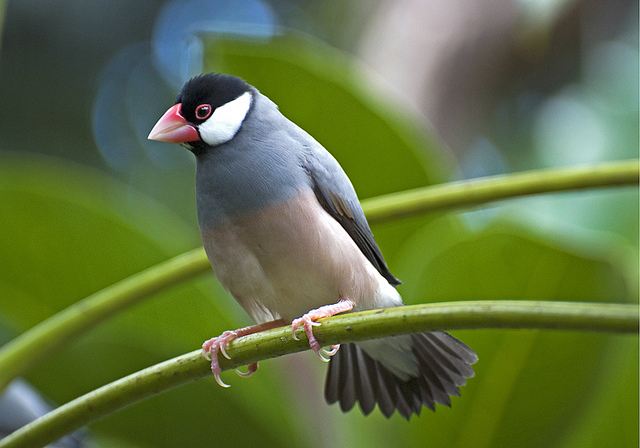
The handsome Java sparrow — grey body, black cap, white cheeks and a thick pink bill — was once one of Bali's most familiar rice-field birds and appears on Indonesian coins. Heavy trapping for the pet trade has made it genuinely scarce and it is now classed as Endangered. Treat any wild flock around Ubud or Kuta as a special sighting.
FactThe night shift: nightjars and owls
Bali's birding doesn't end at sunset. As dusk falls over dry country and rice fields, savanna nightjars start their chirping 'chweep' calls and hawk insects over open ground, while barn owls ghost out of palm crowns and Javan owlets call from highland forest. A slow evening walk with a torch near Munduk or the west coast can add a whole second cast of birds.
TipStart at dawn for the best birding
Bali's birds are most active in the first hours after sunrise, roughly 6 to 10am, when the air is cool and the dawn chorus is in full swing. By midday most species retreat into shade and the forests go quiet. Plan bird walks early and save temples and beaches for the afternoon heat.
TipHire a local bird guide
A good local guide is worth every rupiah: Balinese bird guides know which fruiting tree the barbets are using and can identify dozens of species by call alone. In West Bali National Park a ranger-guide is compulsory anyway. Ask your hotel or the park office to arrange one, and start at dawn.
TipPack binoculars, dress quietly
Even a modest pair of binoculars transforms Balinese birding — most species are small, high in the canopy or across a mudflat. Wear dull greens and browns rather than white or bright colours, move slowly and talk softly. A phone bird app with Indonesian species helps you put names to what you see.
TipMatch the season to your targets
The dry season, roughly April to October, gives the easiest walking, clearest views and breeding activity among resident birds. Come between October and March instead if you want the migrant waders, raptors and warblers that escape the northern winter — just expect afternoon downpours. Serious birders often combine both: residents early in a trip, coast and mudflats later.
TipDon't buy caged wild birds
Keeping songbirds is a beloved Indonesian hobby, but demand for wild-caught birds has devastated species like the Bali starling and Java sparrow. As a visitor, never buy wild birds or pay to release caged ones — releases usually doom the bird and fund more trapping. Put your money into bird walks and parks instead, so living wild birds are worth more than caged ones.
TipWords to know
burung — bird;
kedis — bird (Balinese);
jalak Bali — Bali starling;
jalak — starling / myna;
elang — eagle;
bangau — heron / egret;
kakatua — cockatoo;
merpati — dove / pigeon;
burung hantu — owl;
cendrawasih — bird of paradise;
rangkong — hornbill;
tekukur — spotted dove;
kutilang — sooty-headed bulbul;
beo — hill myna;
cekakak — kingfisher;
terbang — to fly;
sayap — wing;
paruh — beak;
bulu — feather;
sarang — nest;
berkicau — to chirp / sing (of birds);
teropong — binoculars
See also: related sets
The best birding sits in the same forests as everything else: Munduk's falls in Waterfalls, the twin-lakes orchid in Orchids, and Ubud's monkey forest in Monkeys.