FactWalter Spies: the man who put Bali on the art map
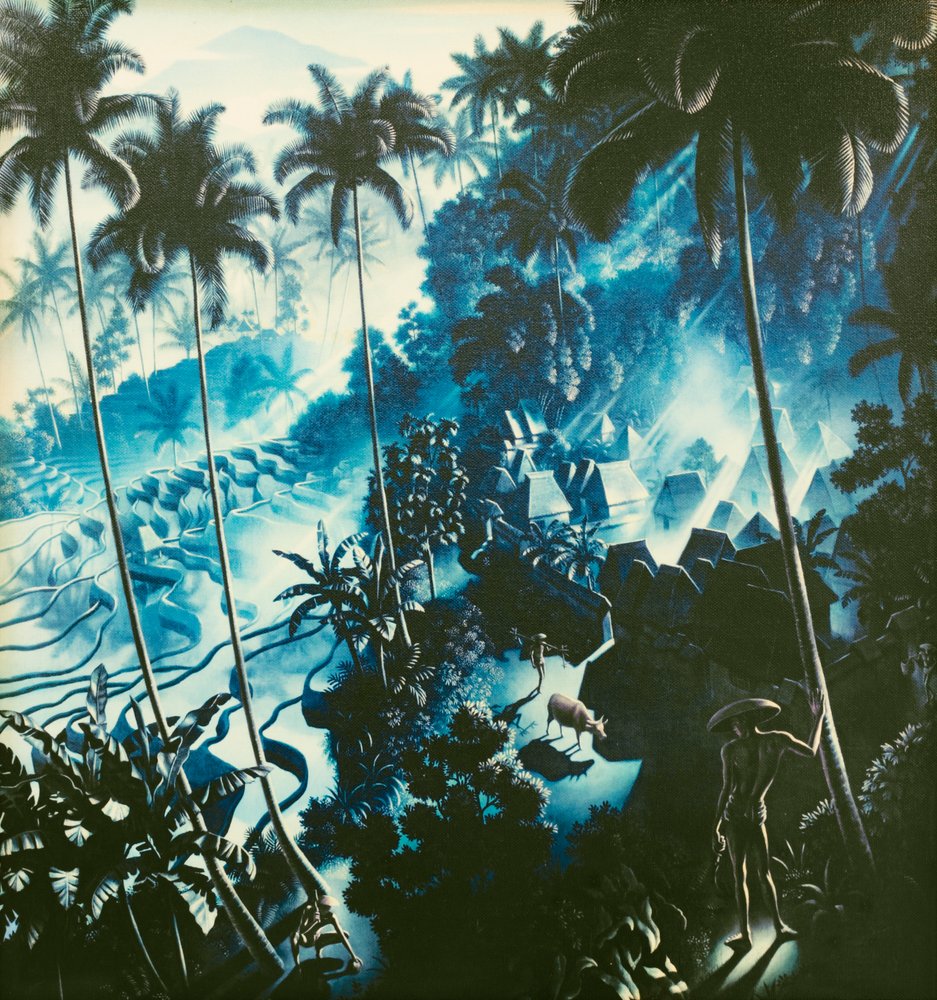
German painter Walter Spies (1895–1942) arrived in Bali in 1927 and settled in Ubud, where his house at Campuan became the meeting place for every visiting artist, anthropologist and writer of the 1930s. He painted fewer than 80 canvases in his life, of which only about 40 survive, and his dreamlike, minutely detailed jungle landscapes set the image of Bali the world still carries. The largest collection of his work is held at ARMA in Ubud.
FactSpies, kecak and a death at sea
Spies did more than paint: he helped shape the kecak dance with Beryl de Zoete in the 1930s, collected Balinese music, and was the first curator of the Bali Museum in Denpasar. In 1938 he was arrested by the Dutch colonial authorities and jailed for nine months. In January 1942, as a German national, he was deported on the SS Van Imhoff; the ship was bombed by Japanese planes off Nias and Spies drowned, aged 46.
FactRudolf Bonnet: the Dutchman who stayed
Dutch painter Rudolf Bonnet (1895–1978) arrived in Bali in 1929 and never really left. Where Spies painted dreamlike jungles, Bonnet painted Balinese people — dancers, priests and villagers — in a warm, realistic style, and he was a tireless organiser and teacher. He designed Museum Puri Lukisan, Bali's first art museum, which opened in Ubud in 1956.
FactPita Maha: the artists' cooperative of 1936
On 29 January 1936 Spies, Bonnet, Lempad and the Ubud prince Cokorda Gde Agung Sukawati founded Pita Maha, an artists' cooperative that at its peak had around 150 members. It set quality standards, found buyers for Balinese work and steered painting away from purely religious subjects towards scenes of daily life. It is the founding moment of modern Balinese art, and the name still appears on gallery labels today.
FactI Gusti Nyoman Lempad: the ancient master
I Gusti Nyoman Lempad (1862?–1978) was a stone carver and architect — an undagi — who built palaces and temples around Ubud, including the Saraswati Water Temple beside the lotus pond. He only began drawing in his seventies, producing hundreds of spare ink drawings of Balinese mythology that are now among the most sought-after Balinese works. He died on 25 April 1978, reportedly choosing the day himself, at around 115 years old.
FactIda Bagus Made Nadera: the priest-painter
Ida Bagus Made Nadera (1910–1998) was a high-caste Balinese painter from Tegallinggah whose work bridges the old temple style and the new Ubud school. A priest as well as an artist, he painted Ramayana and Mahabharata scenes in fine, crowded detail, and he was one of the leading figures of Pita Maha. His work is a fixture of the Neka Art Museum and Museum Puri Lukisan collections.
FactI Gusti Made Deblog: the Batuan storyteller
I Gusti Made Deblog (1910–1978) was a leading painter of the Batuan village school, famous for paintings so densely packed with figures that every square centimetre tells part of the story. His 1936 work 'The Birth of Hanuman' is one of the best-known Balinese paintings of the period. Deblog's crowded, dark-toned scenes are the classic example of the Batuan style at its most theatrical.
FactAnak Agung Gde Sobrat: the market painter
Anak Agung Gde Sobrat (1919–1992) was a Ubud prince and painter who taught at the Yogyakarta Academy of Fine Arts from 1957 to 1959, one of the first Balinese artists to teach in Java. His best-known subject was the Balinese market — women with baskets, fruit stalls and bargaining crowds — painted with a gentle humour. His 'Balinese Market' hangs in Museum Puri Lukisan.
FactAntonio Blanco: the flamboyant Spaniard of Ubud
Manila-born Spanish painter Antonio Blanco (1912–1999) arrived in Bali in 1952, married the Balinese dancer Ni Ronji in 1953, and was given land by the King of Ubud, on which he built his studio and home. He painted erotic, romantic portraits of Balinese women in a lush, expressive style and became Ubud's most famous resident artist. His museum, the Blanco Renaissance Museum, opened on 28 December 1998 and holds more than 300 of his works.
FactArie Smit and the Young Artists of Penestanan
Dutch painter Arie Smit (born 1916, Zaandam) settled in Bali in 1956 and, from 1960, taught a group of untrained young men from Penestanan village near Ubud — the Young Artists movement. He gave them paint and canvas and told them to paint what they saw, producing bright, naive scenes of village life, birds and rice fields. At its peak the movement had 300–400 followers, and its cheerful style is still the one most tourists picture when they think of Balinese painting.
FactTheo Meier, Le Mayeur and the Sanur school
While Ubud drew the painters, Sanur drew them too: Swiss artist Theo Meier (1908–1982) lived in Sanur from 1934 to 1955, painting Gauguin-influenced scenes of fishermen and temples. Belgian painter Adrien-Jean Le Mayeur (1880–1958) settled in Sanur in 1932, married the dancer Ni Pollok in 1935, and painted her hundreds of times; his house is now the Le Mayeur Museum, established on 28 August 1957 with about 88 paintings, and it reopened on 11 August 2025 after revitalisation.
FactAffandi: Indonesia's great expressionist
Affandi (1907–1990), born in Cirebon, Java, was Indonesia's most famous modern painter, known for squeezing paint straight from the tube and smearing it with his fingers. He first visited Bali in 1939 and returned in 1957, painting cockfights, Barong dances and sun-baked landscapes in thick, swirling colour. His work hangs in the Neka Art Museum and Museum Pasifika, and his Bali paintings are among the most valuable Indonesian works on the market.
FactMade Wianta: Bali's contemporary maestro
Made Wianta (1949–2020), born in Apuan, Tabanan, was Bali's most revered contemporary artist — a painter, poet and thinker who broke with classical Balinese painting and moved through geometry, calligraphy, installation and performance art over a career of some 14,000 works. He lived in Brussels from 1975 to 1977, represented Indonesia at the Venice Biennale in 2003, and died on 13 November 2020. His Mandala series, reworking the Balinese system of nine directions, is his best-known work.
FactNyoman Nuarta and the giant Garuda
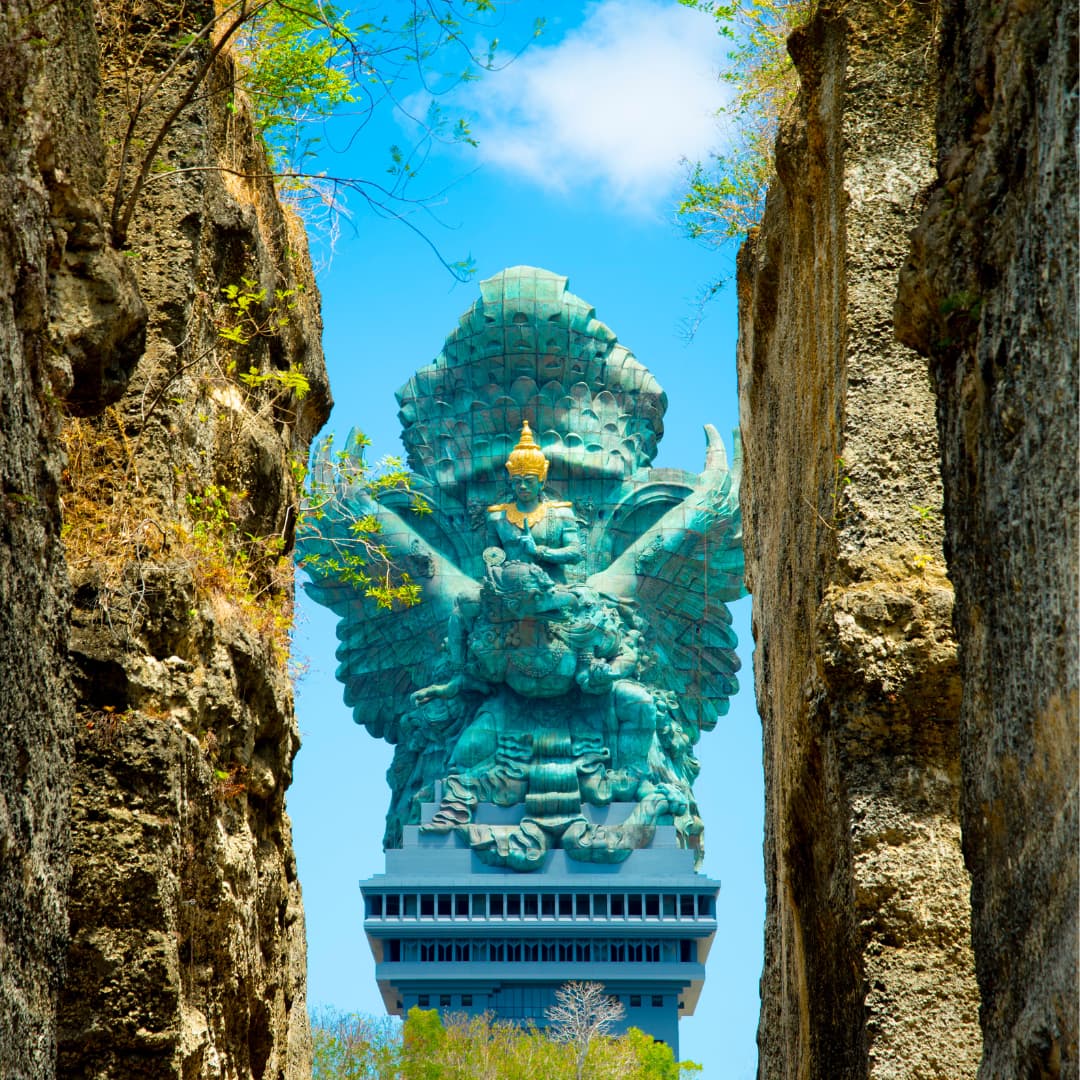
Sculptor I Nyoman Nuarta (born 14 November 1951, Tabanan) spent 28 years building the Garuda Wisnu Kencana statue at Ungasan in south Bali — the god Vishnu riding his eagle Garuda, made of copper and brass in 754 modules built in Bandung and trucked to Bali. Inaugurated on 22 September 2018, the statue stands about 121 metres tall including its pedestal, making it the tallest statue in Indonesia. Nuarta also designed the Jalesveva Jayamahe naval monument in Surabaya.
FigureNyoman Masriadi: the million-dollar Balinese painter
I Nyoman Masriadi (born 1973) is the most commercially successful living Indonesian artist: his triptych 'The Man From Bantul (The Final Round)' sold for US$1,000,725 at Sotheby's Hong Kong in October 2008, a record for a contemporary Southeast Asian work at auction. His big, comic-book-style paintings of muscular superheroes and boxers — he once sold souvenir paintings to tourists for about US$20 — now fetch hundreds of thousands of dollars. He paints only eight to ten canvases a year.
FactKamasan painting: Bali's oldest tradition
Kamasan painting, from the village of Kamasan near Klungkung, is Bali's oldest painting tradition, dating to the 16th century. It uses flat, wayang-style figures with no perspective, drawn in bold black outlines and filled with natural earth pigments on cloth or bark. The subjects are always stories — the Ramayana, the Mahabharata and local legends — and the paintings were originally made for temples and palaces, not for sale. You can still see painters at work in Kamasan today.
FactBatuan painting: every centimetre tells a story
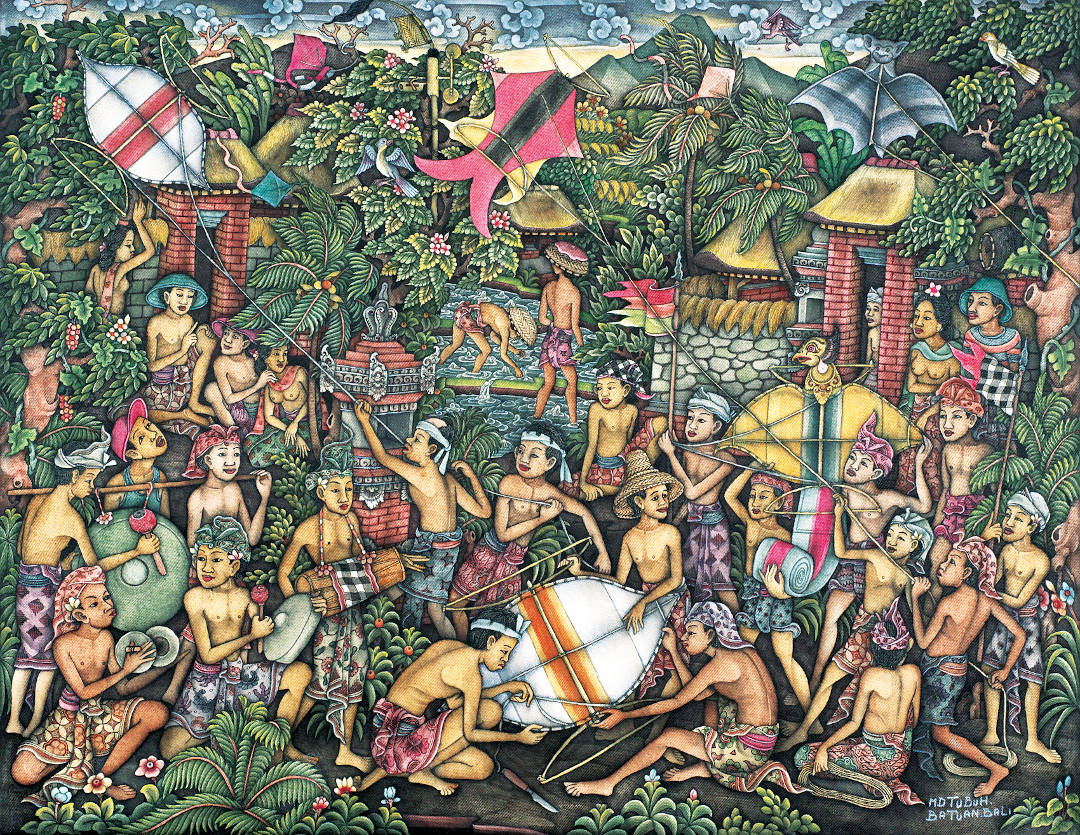
Batuan, a village just south of Ubud, developed its own painting style in the 1930s: dark, densely packed scenes in which dozens — sometimes hundreds — of tiny figures fill the whole canvas, with no empty space at all. The subjects range from temple festivals and cockfights to demons, rice planting and everyday village gossip. Look closely at a Batuan painting and you will keep finding new jokes and details in the corners.
TipHow to read a Balinese painting
Traditional Balinese painting has no perspective and no single viewpoint: figures are shown flat, like wayang puppets, and the most important person is simply the biggest. Stories read across the canvas rather than into it, and the same character may appear several times in one painting at different moments of the tale. If you can spot the demon (big teeth, bulging eyes), the prince (fine features, gold crown) and the clown servants, you can follow almost any classical painting.
PlaceMuseum Puri Lukisan: Bali's first art museum
Museum Puri Lukisan, on Jalan Raya Ubud about 300 metres west of Ubud Palace, is the oldest art museum in Bali — opened in 1956 and designed by Rudolf Bonnet with the Ubud royal family. Its three pavilions hold the classic collection: Kamasan and Batuan paintings, Pita Maha works, Spies, Bonnet and Lempad, plus woodcarving. Open daily 9am–6pm; entry is about IDR 95,000 for adults, and children under 15 enter free with an adult. Allow about 1.5 hours.
PlaceNeka Art Museum: the collector's museum
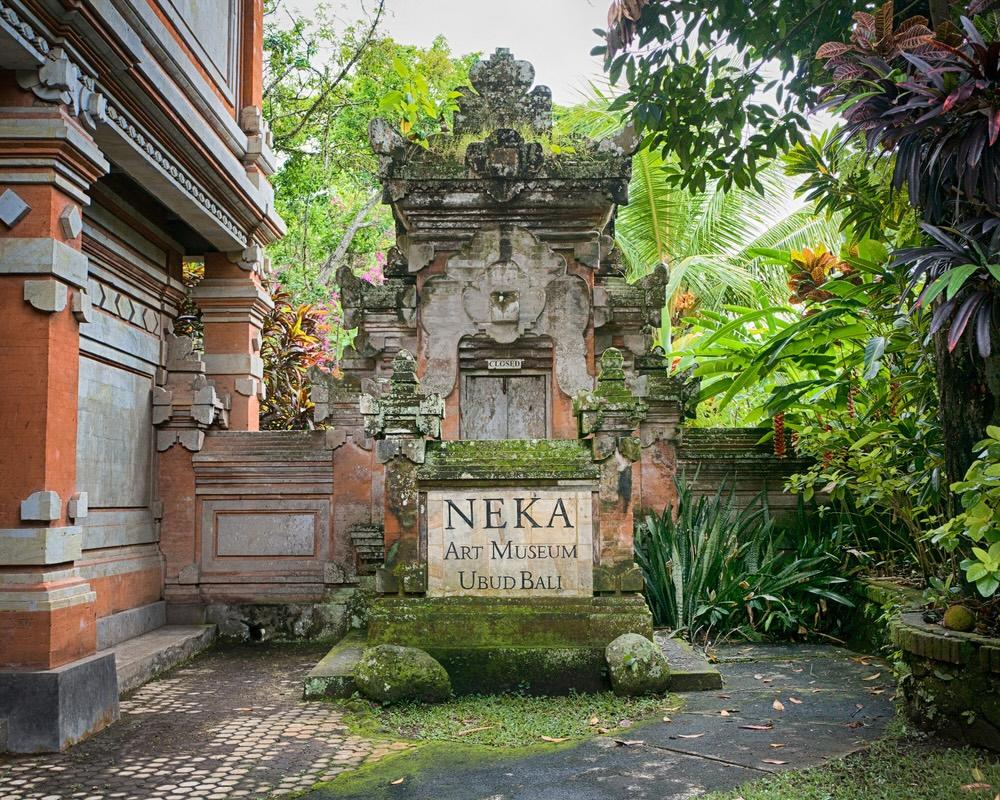
The Neka Art Museum, on Jalan Raya Sanggingan in Ubud, was founded by Suteja Neka, the son of a woodcarver who became Bali's best-known art dealer. It is the most complete single survey of Balinese painting anywhere: rooms trace the story from Kamasan and Batuan through Spies, Bonnet and the Young Artists to Affandi and contemporary work, with a strong Arie Smit collection. Open daily 9am–5pm; entry is about IDR 150,000 for adults, IDR 75,000 for students and children aged 6–12, and free for under-6s.
PlaceARMA: art, gardens and evening dance
The Agung Rai Museum of Art (ARMA), on Jalan Raya Pengosekan in Ubud, opened on 9 June 1996 and is part museum, part cultural centre, set in gardens with ponds and pavilions. Its collection runs from classical Kamasan work to Spies, Bonnet, Raden Saleh and contemporary Indonesian art, and it holds the largest collection of Walter Spies paintings anywhere. Open daily 9am–6pm; entry is about IDR 150,000 for adults including a coffee or tea, under-6s free. Stay for the 7pm dance on the open stage — tickets are separate, about IDR 150,000.
PlaceBlanco Renaissance Museum: the artist's own palace
The Blanco Renaissance Museum, on a hill at Campuan in Ubud, is the house, studio and garden Antonio Blanco built for himself — a flamboyant compound entered through a towering sculptural gateway, with his paintings hung in the rooms where he worked. It holds more than 300 of his works, mostly portraits of Balinese women, plus his collection of art and curiosities. Entry is about IDR 50,000. Go for the building and the garden as much as the paintings.
PlaceMuseum Pasifika: Bali's biggest art museum
Museum Pasifika, in the ITDC complex at Nusa Dua, opened in 2006 and holds more than 600 works by 200 artists from 25 countries across eleven rooms — the largest collection of Asia-Pacific art in Asia. It starts with Indonesian and Balinese artists, including Raden Saleh and Le Mayeur, then moves through Indochina, Japan and China to Vanuatu and Tahiti, with a room of Gauguin and Pacific art. Open daily 10am–6pm; entry is about IDR 100,000–110,000 for foreign visitors, and children under 12 are free. Allow 2–3 hours.
PlaceSika Gallery and Tonyraka: where contemporary Bali hangs
For living, contemporary art, skip the museums and go to the galleries. Sika Gallery, on Jalan Raya Sanggingan in Ubud, is run by Made Sika and shows emerging and mid-career Indonesian contemporary artists, open Tuesday to Sunday 10am–6pm. Tonyraka Art Gallery, on Jalan Raya Mas, was founded as a woodcarving gallery in 1968 and turned to modern and contemporary art under Tony Hartawan from 1997; it is open daily 8am–10pm and now has an art lounge restaurant in its garden. Both are free to browse.
TipA half-day Ubud art walk
Do the museums in this order and you walk through the whole history of Balinese art in one morning. Start at Museum Puri Lukisan on Jalan Raya Ubud (the 1930s story), walk south to ARMA on Jalan Raya Pengosekan (Spies and the classics in a garden), then continue to the Neka Art Museum on Jalan Raya Sanggingan (the full survey). Finish at Sika Gallery, a few doors away, for what young Balinese artists are painting now. Three museums, about four hours, and everything is within a 30-minute walk.
FigureWhat Balinese art costs
Prices vary enormously, and knowing the tiers stops you overpaying. Small souvenir paintings in the Ubud and Sukawati markets run about IDR 150,000–500,000. Originals by working Balinese artists in Ubud galleries are roughly IDR 3–24 million, depending on size and reputation. Large works by established names reach IDR 30–160 million or more, and at auction the top Indonesian contemporary works have passed US$1 million. All figures are approximate and vary by artist, size and gallery.
TipGalleries or markets: where to buy
Buy in a gallery when you want an original with a name attached: prices are fixed, the artist is identified, and you get a receipt and usually a certificate. Buy in a market when you want a decorative souvenir: Ubud Art Market and Sukawati are the main hunting grounds, prices are negotiable, and most of what you see is painted quickly for tourists rather than by a named artist. Never buy from a tout on the street — the work is almost always a copy, and the price is not a bargain.
TipSpotting a fake: certificates and clues
A genuine original should come with a certificate of authenticity from the gallery or the artist, the artist's signature on the front or back, and a story you can check — where the artist lives, where they exhibit. Warning signs are a famous name at a silly price, identical 'originals' in several shops, and a canvas that looks printed rather than painted: hold it at an angle and look for raised brushwork and uneven paint. If a seller claims a painting is by Spies, Bonnet or Lempad, walk away — their surviving works are in museums and auction houses, not on market stalls.
TipBargaining for art — and when not to
In markets, bargaining is expected: open at roughly 40% of the first asking price and meet somewhere in the middle, politely and with a smile — it is a social exchange, not a fight. In a proper gallery, prices are fixed and haggling is rude; the most you can ask is whether there is a discount for paying cash. Never bargain for a work in a temple or a village workshop where the artist is present and the price is their livelihood — and never photograph an artist's work in progress without asking first.
FactArt festivals and events to plan around
Bali's art calendar peaks twice a year. The Bali Arts Festival runs from mid-June to mid-July with painting exhibitions, competitions and performances, mostly in Denpasar. The Ubud Writers & Readers Festival, usually in late October, brings writers and artists together in Ubud with exhibitions and talks. Galleries also hold their own openings — Sika and Tonyraka in Ubud, and the Sudakara Art Space in Sanur, are the ones to watch — and openings are usually free and open to everyone.
TipWords to know
seni — art;
seni rupa — fine art; visual art;
lukisan — painting; a painted picture;
pelukis — painter;
seniman — artist;
pematung — sculptor;
patung — statue; sculpture;
ukiran — carving; carved work;
pahat — to chisel; to carve;
kuas — paintbrush;
cat — paint;
kanvas — canvas;
warna — colour;
gambar — picture; drawing;
galeri — gallery;
pameran — exhibition;
karya — a work; a creation;
asli — original; authentic; genuine;
tiruan — imitation; copy; fake;
taksu — artistic charisma; divine inspiration in a performance or work;
rerajahan — sacred drawing; ritual sketch;
undagi — master builder; architect of temples and palaces
See also: related sets
For the museums and the festivals that bookend this set, see these cards in other sets.